# Help Center

<figure><img src="/files/UUTPno31IJUw3MYBlbfb" alt=""><figcaption></figcaption></figure>

**Welcome!**\
Ma Earth connects nature projects with people who believe in their work. Whether you're stewarding land or supporting those who do, this is your community.

<table data-card-size="large" data-view="cards"><thead><tr><th></th><th></th><th data-type="content-ref"></th><th data-hidden></th><th data-hidden data-card-cover data-type="image">Cover image</th><th data-hidden></th><th data-hidden data-card-target data-type="content-ref"></th></tr></thead><tbody><tr><td><h4><strong>About Ma Earth</strong></h4></td><td>The platform, our philosophy, and the technology powering the work.</td><td><a href="/pages/30zzkhV1EG43Hwp61TGj">/pages/30zzkhV1EG43Hwp61TGj</a></td><td><h4><i class="fa-earth-americas">:earth-americas:</i></h4></td><td><a href="/files/Sc2iXghWA41Lu0FTSgma">/files/Sc2iXghWA41Lu0FTSgma</a></td><td></td><td><a href="/pages/30zzkhV1EG43Hwp61TGj">/pages/30zzkhV1EG43Hwp61TGj</a></td></tr><tr><td><h4><strong>For Land Stewards</strong></h4></td><td>Apply for funding, prepare your campaign, and share your regenerative work.</td><td><a href="/pages/AuBrubbvB8tiRxLEilts">/pages/AuBrubbvB8tiRxLEilts</a></td><td><h4><i class="fa-leaf">:leaf:</i></h4></td><td><a href="/files/UZjwiCWHOgvhQ3IXoU1l">/files/UZjwiCWHOgvhQ3IXoU1l</a></td><td></td><td><a href="/pages/AuBrubbvB8tiRxLEilts">/pages/AuBrubbvB8tiRxLEilts</a></td></tr><tr><td><h4><strong>For Donors</strong></h4></td><td>Donating on Ma Earth, unlocking matching funds, and supporting nature projects.</td><td><a href="/pages/lcALQkyUiNgKrOBUO78Q">/pages/lcALQkyUiNgKrOBUO78Q</a></td><td><h4><i class="fa-hands-holding-heart">:hands-holding-heart:</i></h4></td><td><a href="/files/FTxBIUxDnb2VjWJgmPmN">/files/FTxBIUxDnb2VjWJgmPmN</a></td><td></td><td><a href="/pages/lcALQkyUiNgKrOBUO78Q">/pages/lcALQkyUiNgKrOBUO78Q</a></td></tr><tr><td><h4><strong>For Host Partners</strong></h4></td><td>Host projects on Ma Earth by receiving and managing crowdfunding donations and matching funds.</td><td><a href="/pages/gXzBN5T45HQ0eTSYTpit">/pages/gXzBN5T45HQ0eTSYTpit</a></td><td></td><td><a href="/files/qGuSIRMQfatWPj5xKGCN">/files/qGuSIRMQfatWPj5xKGCN</a></td><td></td><td><a href="/pages/gXzBN5T45HQ0eTSYTpit">/pages/gXzBN5T45HQ0eTSYTpit</a></td></tr></tbody></table>


# Quickstart

<figure><img src="https://gitbookio.github.io/onboarding-template-images/quickstart-hero.png" alt=""><figcaption></figcaption></figure>

Beautiful documentation starts with the content you create — and GitBook makes it easy to get started with any pre-existing content.

{% hint style="info" %}
Want to learn about writing content from scratch? Head to the [Basics](/basics/editor) section to learn more.
{% endhint %}

### Import

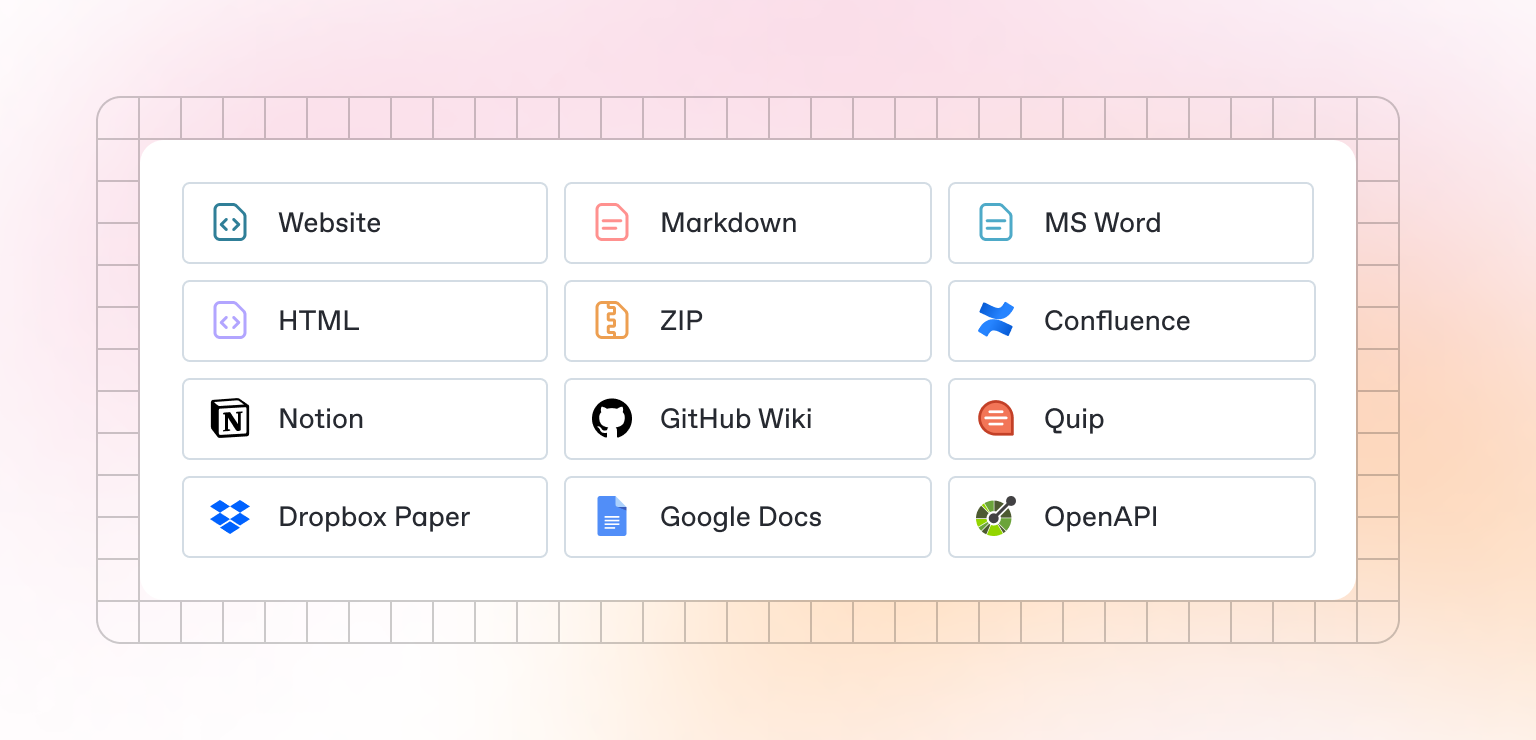
GitBook supports importing content from many popular writing tools and formats. If your content already exists, you can upload a file or group of files to be imported.

<div data-full-width="false"><figure><img src="https://gitbookio.github.io/onboarding-template-images/quickstart-import.png" alt=""><figcaption></figcaption></figure></div>

### Sync a repository

GitBook also allows you to set up a bi-directional sync with an existing repository on GitHub or GitLab. Setting up Git Sync allows you and your team to write content in GitBook or in code, and never have to worry about your content becoming out of sync.


# Publish your docs

Once you’ve finished writing, editing, or importing your content, you can publish your work to the web as a docs site. Once published, your site will be accessible online only to your selected audience.

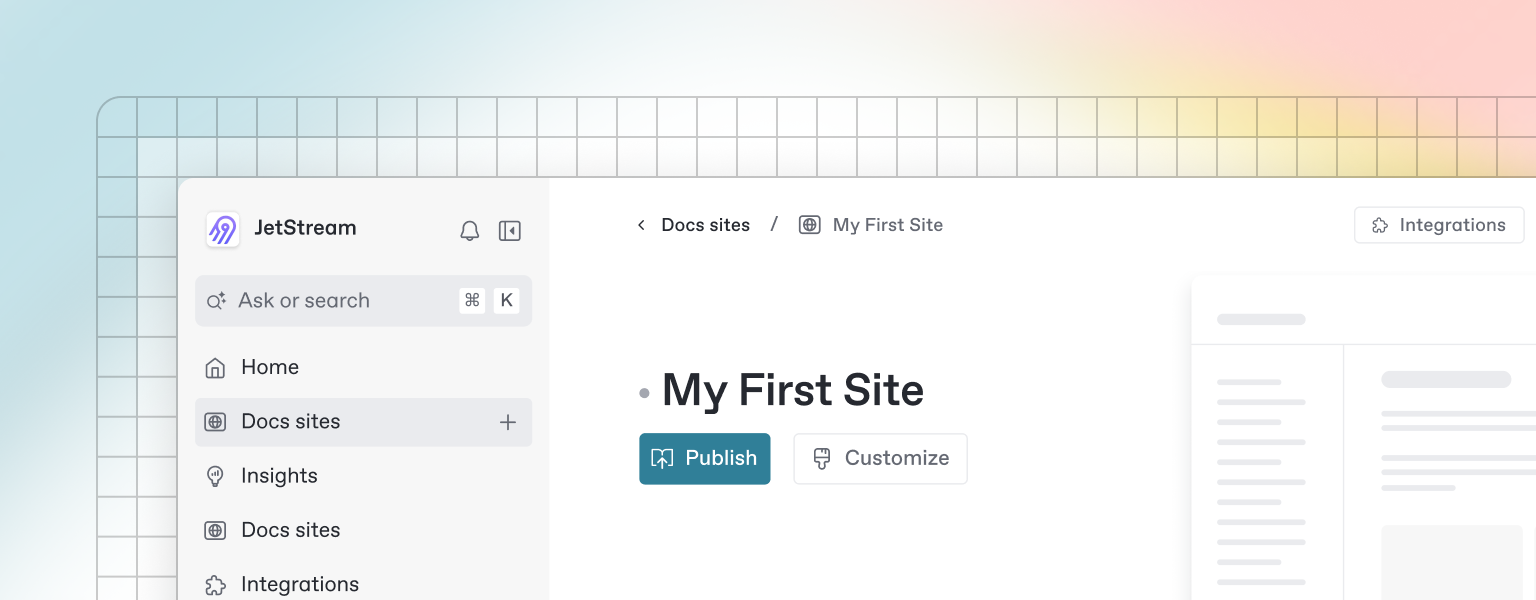
You can publish your site and find related settings from your docs site's homepage.

<figure><img src="https://gitbookio.github.io/onboarding-template-images/publish-hero.png" alt=""><figcaption></figcaption></figure>


# Editor

GitBook has a powerful block-based editor that allows you to seamlessly create, update, and enhance your content.

<figure><img src="https://gitbookio.github.io/onboarding-template-images/editor-hero.png" alt=""><figcaption></figcaption></figure>

### Writing content

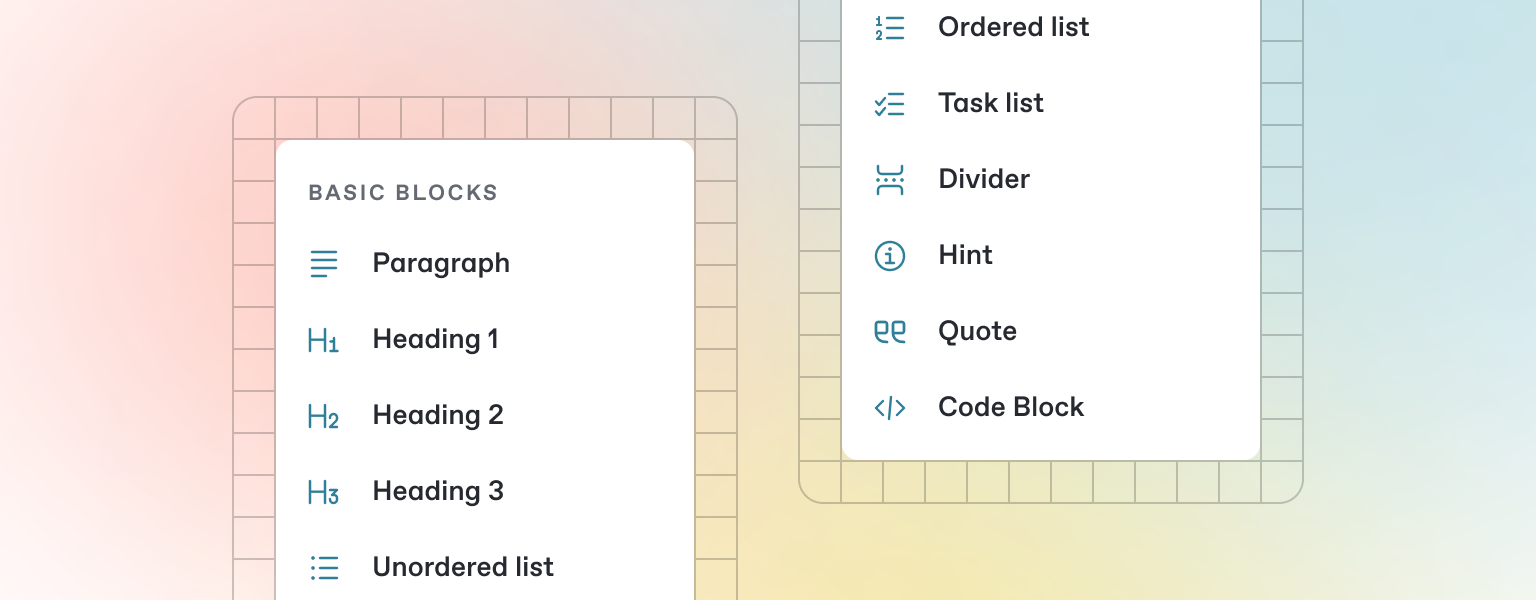
GitBook offers a range of block types for you to add to your content inline — from simple text and tables, to code blocks and more. These elements will make your pages more useful to readers, and offer extra information and context.

Either start typing below, or press `/` to see a list of the blocks you can insert into your page.

### Add a new block

{% stepper %}
{% step %}

#### Open the insert block menu

Press `/` on your keyboard to open the insert block menu.
{% endstep %}

{% step %}

#### Search for the block you need

Try searching for “Stepper”, for exampe, to insert the stepper block.
{% endstep %}

{% step %}

#### Insert and edit your block

Click or press Enter to insert your block. From here, you’ll be able to edit it as needed.
{% endstep %}
{% endstepper %}


# Markdown

GitBook supports many different types of content, and is backed by Markdown — meaning you can copy and paste any existing Markdown files directly into the editor!

<figure><img src="https://gitbookio.github.io/onboarding-template-images/markdown-hero.png" alt=""><figcaption></figcaption></figure>

Feel free to test it out and copy the Markdown below by hovering over the code block in the upper right, and pasting into a new line underneath.

```markdown
# Heading

This is some paragraph text, with a [link](https://docs.gitbook.com) to our docs. 

## Heading 2
- Point 1
- Point 2
- Point 3
```

{% hint style="info" %}
If you have multiple files, GitBook makes it easy to import full repositories too — allowing you to keep your GitBook content in sync.
{% endhint %}


# Images & media

GitBook allows you to add images and media easily to your docs. Simply drag a file into the editor, or use the file manager in the upper right corner to upload multiple images at once.

<figure><img src="https://gitbookio.github.io/onboarding-template-images/images-hero.png" alt=""><figcaption><p>Add alt text and captions to your images</p></figcaption></figure>

{% hint style="info" %}
You can also add images simply by copying and pasting them directly into the editor — and GitBook will automatically add it to your file manager.
{% endhint %}


# Interactive blocks

In addition to the default Markdown you can write, GitBook has a number of out-of-the-box interactive blocks you can use. You can find interactive blocks by pressing `/` from within the editor.

<figure><img src="https://gitbookio.github.io/onboarding-template-images/interactive-hero.png" alt=""><figcaption></figcaption></figure>

### Tabs

{% tabs %}
{% tab title="First tab" %}
Each tab is like a mini page — it can contain multiple other blocks, of any type. So you can add code blocks, images, integration blocks and more to individual tabs in the same tab block.
{% endtab %}

{% tab title="Second tab" %}
Add images, embedded content, code blocks, and more.

```javascript
const handleFetchEvent = async (request, context) => {
    return new Response({message: "Hello World"});
};
```

{% endtab %}
{% endtabs %}

### Expandable sections

<details>

<summary>Click me to expand</summary>

Expandable blocks are helpful in condensing what could otherwise be a lengthy paragraph. They are also great in step-by-step guides and FAQs.

</details>

### Embedded content

{% embed url="<https://www.youtube.com/watch?v=YILlrDYzAm4>" %}

{% hint style="info" %}
GitBook supports thousands of embedded websites out-of-the-box, simply by pasting their links. Feel free to check out which ones[ are supported natively](https://iframely.com).
{% endhint %}


# Integrations

GitBook integrations allow you to connect your GitBook spaces to some of your favorite platforms and services. You can install integrations into your GitBook page from the *Integrations* menu in the top left.

<figure><img src="https://gitbookio.github.io/onboarding-template-images/integrations-hero.png" alt=""><figcaption></figcaption></figure>

### Types of integrations

<table data-card-size="large" data-view="cards"><thead><tr><th></th><th></th><th data-hidden data-card-target data-type="content-ref"></th><th data-hidden data-card-cover data-type="files"></th><th data-hidden></th></tr></thead><tbody><tr><td><strong>Analytics</strong></td><td>Track analytics from your docs</td><td><a href="https://www.gitbook.com/integrations#analytics">https://www.gitbook.com/integrations#analytics</a></td><td></td><td></td></tr><tr><td><strong>Support</strong></td><td>Add support widgets to your docs</td><td><a href="https://www.gitbook.com/integrations#support">https://www.gitbook.com/integrations#support</a></td><td></td><td></td></tr><tr><td><strong>Interactive</strong></td><td>Add extra functionality to your docs</td><td><a href="https://www.gitbook.com/integrations#interactive">https://www.gitbook.com/integrations#interactive</a></td><td></td><td></td></tr><tr><td><strong>Visitor Authentication</strong></td><td>Protect your docs and require sign-in</td><td><a href="https://www.gitbook.com/integrations#visitor-authentication">https://www.gitbook.com/integrations#visitor-authentication</a></td><td></td><td></td></tr></tbody></table>


# About Ma Earth

What is MaEarth?

Ma Earth is a collective funding platform for community-led regeneration. We connect land stewards with resources to restore ecosystems, protect watersheds, and care for the living world.&#x20;

Across the planet, communities are leading their own regeneration. The challenge is not a lack of solutions. It is a lack of flow. An estimated $1 trillion per year funding gap prevents community-led regeneration from accessing the resources it needs.

### Our Approach

Most funding systems concentrate decision-making power in the hands of a few. Ma Earth puts that power in the hands of communities instead through:

**Democratic allocation.** Through a quadratic funding model, the number of supporters shapes where resources flow, not just the size of donations.&#x20;

**Trust-based relationships.** We don't ask for lengthy proposals or burdensome reports. We ask for your story, your goals, and updates that keep your community engaged with your work.

[**Collaborative funding rounds.**](/resources-for-land-stewards/about-funding-rounds) Projects aren't competing against each other. When one project succeeds, the whole round benefits..

**Verifiable impact.** Through [Hypercerts](/ma-earth/our-technology/hypercerts), we create transparent, verifiable records of restoration — so funders can see what their support makes possible, and land stewards get recognized for the work they're already doing.

### Our Vision

Ma Earth envisions a world where the economy is in service to life — where prosperity is measured not by accumulation, but by the vitality of land, water, and community.

We are part of a broader movement shifting the economy from extractive to regenerative, from transactional to relational, from commodification to reverence. A movement that trusts communities to lead regeneration, and builds the infrastructure to resource them doing it.

Ma Earth is an invitation to collective stewardship. Small acts of care, multiplied across communities and landscapes, have the power to shift the whole.

### Learn More

**Get started:**

* [Learn about collective funding](/ma-earth/funding-explained/ma-earths-funding-model)
* [Apply to the next round](https://maearth.com/fundraise)

**Connect:**

* [Join community calls](/resources-for-land-stewards/funding-round-3-hub/community-calls)
* [Contact us](https://maearth.com/contact)

**Questions?**

* Browse our Help Center for detailed guides:
  * [For land stewards](/resources-for-land-stewards/getting-started-as-a-land-steward)
  * [For donors](/resources-for-donors/getting-started-as-a-donor)
  * [For trusted evaluators](/resources-for-trusted-evaluators/trusted-evaluator-guide)
  * [For host partners](/resources-for-host-partners/host-partner-guide)


# Our Story

A collective funding platform for community-led regeneration

Ma Earth is part of a growing movement responding to the call of our time: to care for the living world.

We are living through a convergence of ecological, social, and economic breakdowns. And yet, across the planet, communities are restoring land, protecting watersheds, cultivating food systems, and tending ecosystems. Indigenous knowledge holders, local stewards, and grassroots leaders carry forms of care that have sustained life for generations.

The challenge is not a lack of solutions. It is a lack of flow.

An estimated $1 trillion per year funding gap prevents regenerative and community-led initiatives from accessing the resources they need. Most financial systems were designed for extractive industries and short-term returns — not for the stewardship of living systems.

The flow of resources has been dammed.

Ma Earth exists to restore the current.

### The platform is now live!

Ma Earth has launched its collective funding platform, purpose-built for community-led regeneration.

Our inaugural platform round, opening in May 2026, will direct approximately $1,000,000 in matched contributions to \~200 community grassroots land and ecological projects worldwide—the largest round we’ve run to date.\
\ <a href="https://maearth.com/" class="button primary">Ma Earth</a>

Prior to this launch, our community distributed over $400,000 to more than 50 regenerative projects worldwide through two pilot rounds. Now we are building the platform for regeneration to ripple outward.

#### Funding Rounds

Each round opens the flow to community-led projects spanning land restoration, watershed protection, regenerative agriculture, reforestation, and more. Community crowdfunding is multiplied through matching pools meaning the more people who participate, the greater the share each project receives. Many small streams become one powerful current.&#x20;

[Learn more about funding rounds.](/resources-for-land-stewards/about-funding-rounds)

#### Verifiable Impact

Built into the platform [Hypercerts](/ma-earth/our-technology/hypercerts) and impact attestations create verifiable records of restoration on the ground, while evaluators track ecological outcomes in real time. Together, these tools help resources flow through a funding ecosystem built on transparency, trust, and collective coordination.

#### Learning Lab

To further support land stewards, we offer [Learning Lab](https://luma.com/maearth?period=past), an online space to share workshops and cultivate community. At Learning Lab, we’re asking the question: *What practical tools and guidance can help support land regeneration?* Together, we explore real use-cases for environmental technology (such as monitoring, reporting, verification), traditional ecological knowledge practices, and useful frameworks from farmers, ecological advocates, and regenerators.

***

### Where we began

Ma Earth began by listening and learning through [The Regeneration Will Be Funded](https://maearth.com/studio?offering_equal=The+Regeneration+Will+Be+Funded), an interview series exploring regenerative finance and pathways toward a life-affirming economy. To date, we’ve hosted over 150 conversations with leading voices across philanthropy, land stewardship, climate investing, technology, policy, and more.

Ma Earth has been catalyzed by the team at [Biome Trust](https://biometrust.earth/), a philanthropic foundation in service to ecological health and wellbeing. Much of our learning has been at [Mangaroa Farms](https://mangaroa.org/), a living laboratory for regenerative agriculture and community resilience.

### Who’s weaving this together

Ma Earth is a distributed, global effort with a core team, a constellation of extended collaborators, and a growing network of partners, all in service of the same current. We’re grateful for every hand in this weaving. To learn more about the people and organizations behind the work, visit our [<mark style="color:blue;">team page</mark>](https://maearth.com/about).\
\
Ma Earth Foundation is established as a tax-exempt foundation in Zug, Switzerland, with Ma Earth Labs AG operating the platform. Ma Earth US is a program hosted at [Commonweal](https://www.commonweal.org/). The platform is built in partnership with [Hypercerts Foundation](https://hypercerts.org/) and draws on a growing constellation of regenerative finance tools and open digital infrastructure.

### Restoring the flow

Ma Earth envisions a world where the economy shifts from extractive to regenerative, transactional to relational, from commodifying the living world to revering it. Where prosperity is measured not by accumulation, but by the vitality of the watershed.

Ma Earth is an invitation to collective stewardship. Small acts of care, multiplied across communities and landscapes, have the power to shift the whole.

> "When a complex system is far from equilibrium, small islands of coherence in a sea of chaos have the capacity to shift the entire system to a higher order." — Ilya Prigogine

Together, we are restoring the flow. So that in a time of cascading crises, regeneration can take root everywhere.

**Join us.**


# About Regeneration

What does "regenerative" mean?

<mark style="color:$primary;">**Regeneration is the active healing of ecosystems and the communities within them.**</mark> &#x20;

Regeneration returns ecosystems to health, restores ecological integrity, and supports conditions for life to thrive. The most enduring regeneration happens where land and community heal together.

***

### Regenerative vs. sustainable

**Sustainable = maintaining the current state.** *"Don't make it worse. Keep things as they are."*

**Regenerative = actively improving.** *"Heal what's damaged. Support systems to thrive."*

***

### Regeneration in practice

**Soil:** Building topsoil, restoring soil biology, increasing organic matter.

**Water:** Healing watersheds, restoring wetlands, recharging aquifers.

**Biodiversity:** Restoring habitat, removing invasive species, reconnecting ecosystems.

**Agriculture:** Reviving degraded farmland, integrating crops and livestock, reducing chemical inputs.

**Forests:** Replanting native species, restoring canopy structure, reconnecting wildlife corridors.

**Communities:** Strengthening relationships to place, reviving traditional practices, building local resilience.

[See all project categories](/resources-for-land-stewards/project-profile/project-categories).

#### Guiding Principles of Regenerative Land Stewardship

1. Working with natural processes, not against them
2. Restoring relationships between species, people, and place
3. Cultivating abundance through care
4. Seeing the whole system and how its parts relate
5. Moving at the pace of seasons and cycles
6. Observing and listening to the land before acting
7. Centering traditional knowledge systems that have tended land for generations<br>


# Our Technology


# About Certified

What is Certified?

Certified is the sign-in service behind Ma Earth and other regenerative platforms in our network. When you create an account on Ma Earth, you'll receive a Certified ID—a secure and portable universal ID that functions across platforms working on regeneration.

*Think of it like "Sign in with Google" or "Sign in with Apple." Except, with Certified, you own your data.*

#### How does Certified work?

**Every organization gets a unique, permanent identifier**

Every (individual) user and organization receives a unique, permanent identifier when it creates an account on Ma Earth or partner platforms (think of it like a universal ID card for the internet). The organization owns this identity and can manage its own profile across platforms.

That permanent ID never changes, even if you switch platforms or update your username.

[**Your Certified identity works across:**](#user-content-fn-1)[^1]

* Ma Earth (funding for community-led regeneration)
* GainForest (ecosystem monitoring)
* Bluesky (a decentralized social network)
* Other platforms built on the AT Protocol

Create your profile once. Use it everywhere you choose.

**Your data follows you.** Your projects, reputation, and work history are tied to your identity—not locked into any single platform. If you move to a different platform, everything comes with you.

#### Why Certified?

Ma Earth is built on the belief that data should serve communities, not platforms. Certified makes this possible by:

* **Sovereign Data:** Giving you ownership of your data. Your profile, reputation, and work history belong to you.
* **Decentralization:** Distributing power across the network. No single company controls how data flows.
* **Interoperability:** Making your work portable. As more regenerative platforms build on AT Protocol, your history and reputation travel with you.
* **Open Protocol:** Building on open infrastructure. Anyone can build on the same protocols, supporting collaboration across the regenerative ecosystem.

***

#### What about my data?

**Private information** (passwords, email, precise locations, financial details, [additional documentation](/resources-for-land-stewards/project-profile/additional-documentation)) stays private on Ma Earth's servers.

**Public information** (organization name, public project descriptions) is stored on Certified's infrastructure using the [AT Protocol](/ma-earth/our-technology/at-protocol).

**You control what's public.** You decide when to make your organization or project profile public. For example, you can keep your project profile private while preparing your application for a [funding round](/resources-for-land-stewards/about-funding-rounds), then [publish](/resources-for-land-stewards/project-profile/project-profile-visibility#what-happens-when-i-make-my-project-profile-public) when you're ready.

**Can I delete my data?**

Yes. You can delete your information from Certified's servers.

However, like any public information on the internet, someone else may have made a copy—similar to how archived websites may be discoverable online, even after the original is taken down.

[Learn more about organization profile privacy.](/resources-for-land-stewards/organization-profile/organization-profile-visibility#privacy-protection)

[Learn more about project profile privacy.](/resources-for-land-stewards/project-profile/project-profile-visibility)

**What if I don't want to keep my data in Certified?**

You don't have to. You can move your data to another provider, or even into infrastructure your organization runs so your record of stewardship lives somewhere you and the people you trust control directly. Your identity and history come with you.

#### Where can I manage my Certified profile?

Everything is manageable through Ma Earth: your organization page, project pages, and account settings. If you want to explore your Certified profile directly, visit [certified.app](https://certified.app).

***

#### Certified on AT Protocol

Certified is building on the AT Protocol—the same open technology behind the decentralized social media app Bluesky—to make data about projects, reputation, and work history portable, and universally accessible.

[Learn more about the AT Protocol](/ma-earth/our-technology/at-protocol).

#### **Built by Hypercerts Foundation**

Certified is developed and maintained by Hypercerts Foundation, which is building open infrastructure for evaluating, recognizing, and funding community-led regeneration. [Learn more](https://docs.hypercerts.org).

In funding rounds, Ma Earth will integrate with [Hypercerts](/ma-earth/our-technology/hypercerts) to create verifiable certificates that record and recognize regenerative impact. [Certified](/ma-earth/our-technology/about-certified) provides the identity layer that makes this possible.

[^1]: correct? also, are we happy referring to it as an 'identity' or better something simpler like 'login credentials' or account?


# Hypercerts

What is Hypercerts?

Hypercerts are living digital records of impact work. Projects record what they've done or plan to do, evaluators add evidence and trust signals over time, and funders use those shared records to make better decisions about where to direct resources.

#### How Hypercerts work with Ma Earth

When you share [updates](/resources-for-land-stewards/project-updates) about your work through your project dashboard, you can create a Hypercert, a permanent public record of your project's impact.

**That Hypercert is a digital public record that shows:**

* What you set out to do
* What you accomplished
* When and where you did it
* Who funded it
* Who did the work

Think of it like a digital credential for community-led, nature-based work.

Over time, evaluators can add evidence and trust signals to your record, building a verified picture of your work that funders across the ecosystem can see and act on.

**For land stewards, Hypercerts can:**

* **Build reputation.** Funders can see your track record and trust that you'll do what you say.
* **Create transparency.** Your impact is verifiable; it's easy to share and easy for supporters to see.
* **Enable collaboration.** Other organizations and evaluators across the ecosystem can recognize, verify, and build on your work.
* **Attract more support.** Projects with verified impact records consistently draw more funding over time.

#### When would I use Hypercerts?

During or after a project, when you want to:

* Document your impact publicly
* Build credibility for future funding
* Add your work to a growing, transparent global record of regeneration
* Unlock additional funding tied to verified impact

#### Where does this data go?

Hypercerts data is stored on [AT Protocol](/ma-earth/our-technology/at-protocol) infrastructure—permanent, public, and verifiable. Once created, your record can't be altered or taken down. For land stewards proving long-term impact, that's what makes it trustworthy.

[*<mark style="color:$primary;">Learn more about Hypercerts</mark>*](https://hypercerts.org/)*<mark style="color:$primary;">.</mark>*


# AT Protocol

What is the AT Protocol?

<mark style="color:$primary;">The AT Protocol (Authenticated Transfer Protocol) is the decentralized infrastructure that stores your Ma Earth profile data once you make it public.</mark>

#### What does "decentralized" mean?

Instead of your data living on Ma Earth's servers alone, it's stored on an open network that any platform can access.

That means the profile you build on Ma Earth isn't locked here. Once you [make your profile public](/resources-for-land-stewards/organization-profile/organization-profile-visibility) (which is required to participate in a funding round), it can travel with you to other platforms — carrying your reputation and impact record wherever you go.

#### What data is stored on AT Protocol?

When you make your organization or project profile public on Ma Earth, the following data is stored on AT Protocol:

* Organization name and description
* Location (exact or general, depending on your privacy settings)
* Project details, goals, timeline
* Team member information (if public)
* Photos and video you've uploaded
* [Project updates](/resources-for-land-stewards/project-updates)

The following data stays private:

* Your login credentials
* Payment information
* Supporting documentation for your application
* Draft/unpublished projects
* Sensitive location data that you’ve chosen to keep private (even when project is public)

#### Why Ma Earth uses AT Protocol

* **Sovereign data:** You own your data. Your information belongs to you, not Ma Earth.
* **Interoperability:** Your profile travels with you. Build it once, use it across multiple platforms.
* **Transparency:** Your work is visible and verifiable. Regeneration impact is transparent across the ecosystem.
* **Resilience:** Nothing disappears. Data persists even if one platform shuts down.

Ma Earth is not the only platform building on the AT Protocol. A few others include:

* [Bluesky](https://bsky.app/) (social network)
* [GainForest](https://gainforest.earth/#about) (ecosystem monitoring)
* [BlackSky](https://blackskyweb.xyz/) (community governance)
* [Leaflet](https://leaflet.pub/) (publishing platform)
* [Smoke Signal](https://smokesignal.events/) (event platform)

**Important:**

* Once you make your profile public, your data will exist on a decentralized network.
* You can delete your data from AT Protocol. However, as with any public information, copies may persist elsewhere — similar to how archived websites can remain discoverable after the original is taken down.

#### Is this safe?

Yes. AT Protocol is the same technology that powers Bluesky, which has millions of users. It's secure, transparent, and designed for user data ownership.

#### Do I need to understand this to use Ma Earth?

No. You can participate in funding rounds without knowing the technical details. We share it because we believe in the infrastructure we've built on and want to be transparent about how it works.

[<mark style="color:$primary;">Learn more about AT Protocol</mark>](https://atproto.com/)<mark style="color:blue;">.</mark>

<br>


# Troubleshooting

Technical issues on the app

**Technical issues may include:**

* error message
* page not loading
* can’t move to the next step of the application

**If you are experiencing technical issues on the Ma Earth platform, please try the following solutions:**

1. Reload the page and try again
2. Log out and log back in to your account and try again
3. Try to complete the steps in a different browser
4. Try to complete the steps on a different device

If these troubleshooting options don't work, please reach out to us through our [contact form](https://maearth.com/contact), and we will assist you.&#x20;

When reporting an error, it is helpful to include information about your browser and device type so our team can identify the issue more quickly.&#x20;


# Funding Explained


# Ma Earth's Funding Model

How does funding work on Ma Earth?

#### Collective Funding in Action

Ma Earth combines three funding streams to get maximum funding for community-led [regeneration](/ma-earth/about-ma-earth/about-regeneration). Our collective funding model is different from both traditional grants and typical crowdfunding.

#### The three streams

1. **Crowdfunding:** What your community contributes. Reach out to your network, friends, family, colleagues, and other supporters, and they contribute directly to your project through the platform.
2. **Matching funds:** Amplifying community support. The more individual supporters you have (as well as how much you raise), the more matching funds you receive from the matching pool. [Quadratic funding](/ma-earth/funding-explained/quadratic-funding) rewards breadth of community engagement, *as well as* the total donation size.
3. **Bonus funds:** One project's success is everyone's success. If all projects in the round collectively reach a funding target, every project receives additional funds. A rising tide lifts all ships.

<figure><img src="/files/BTY64zICQmgFVwa7bwSZ" alt=""><figcaption></figcaption></figure>

Ma Earth's funding model may be different from what you're used to.

**Traditional grants**

* Apply to many funders separately
* Committee decides
* Wait months
* Extensive reporting required
* Maybe you get funded, maybe not

**Typical crowdfunding**

* Ask your network for support
* Get what you raise, nothing more
* Compete against everyone else on the platform

**Ma Earth**

* Apply once, hear back within weeks
* Run a crowdfunding campaign; your community's support unlocks matching funds from the pool
* Collaborate with other projects toward a shared funding goal
* Success is shared; funding is community-directed
* Build a track record that carries into the next round

[*Learn more about Ma Earth's funding model on the website*](https://maearth.com/fundraise)*.*

***


# Quadratic Funding

What is quadratic funding?

Ma Earth distributes matching funding to projects using an innovative system called quadratic funding. Quadratic funding redistributes decision-making power from donors to communities, meaning community support directly determines how much funding each project receives from the matching pool.

#### How quadratic funding works

With quadratic funding, *the number of supporters matters more than the size of donations*. Community donations effectively vote for where matching funds flow. The more people who back a project, the larger its share of the pool.

The matching pool is funded by Ma Earth Foundation and contributing philanthropic partners.

**Calculating matching funds**

Mathematically, the total matching funds a project receives is calculated by summing the square roots of each direct donation to a project and then squaring the total. A [minimum and maximum](/resources-for-land-stewards/about-funding-rounds/minimum-and-maximum-funding) range is also applied.

*You can learn more about quadratic funding at* [*WTF is QF?*](https://www.wtfisqf.com/) *or check out* [*the original paper*](https://arxiv.org/pdf/1809.06421)*.*

*Or explore the* [*funding simulator*](https://maearth.com/fundraise#simulator) *on our website. Again, this provides broad estimates only.*

#### An example of quadratic funding\*

| Funding Source | Project A       | Project B        |
| -------------- | --------------- | ---------------- |
| Donors         | 5 donors × $200 | 100 donors × $10 |
| Crowdfunded    | $1,000          | $1,000           |
| Matching grant | \~$1,500        | \~$12,000        |
| Total funding  | \~$2,500        | \~$13,000        |

In this example, both projects raised $1,000. Project B's broader community support unlocked significantly more matching funds.

*\*Simplified illustrations. Actual matching amounts vary by round, pool size, number of participating projects, and the number of donors each project attracts. Estimates on the website are only estimates and should be treated as such.*

#### **Ma Earth's 2024 pilot rounds**

* Average matching grant was roughly 10× the amount raised through crowdfunding
* Projects with the most individual supporters saw matching leverage of 25–45×
* Projects with fewer but larger donors received 2–5× in matching funds

***Important: Because Round 3 has received significantly more donations than Rounds 1 and 2, we do not expect the matching leverage to be so large.***

#### What this means for you

**Land stewards:** Focus on reaching many people, rather than finding a few big donors. Every small donation increases your share of the matching pool. Broad community support matters more than donation size.

**Community donors:** Your $10 donation has outsized impact. A donation of any size meaningfully benefits the projects you support.

**Matching pool contributors:** Your capital is allocated by the community, directed to the projects with the broadest grassroots support.

***

#### **Why do some projects with more donations have lower estimated matching?**

In a traditional matching model, the project that raises the most money receives the largest match. However, quadratic funding is specifically designed to amplify the voice of the broader community and reduce the influence of single, large donations.

Because of how the math works, it is possible for a project with more donors and more total funding to receive a smaller matching amount than a project with fewer donors and less funding.

Here's why this happens:

Instead of matching dollars linearly, Quadratic Funding calculates a project's "Match Score" using three standard mathematical steps:

1. Take the square root of each individual donation.
2. Sum all of those square roots together.
3. Square the final sum.

Written as a standard mathematical function, it looks like this:

<mark style="color:$success;">Match Score = ( √Donation\_1 + √Donation\_2 + ... + √Donation\_n )²</mark>

The square root function naturally diminishes the weight of massive donations while highly valuing small ones. This ensures that a project supported genuinely and evenly by a cohesive community receives more public matching than a project funded primarily by a single large contributor.

Large contributions don't "hurt" a project's matching calculations, but they don't have an outsized impact, either.

\ <br>


# Fees

What are the platform and payment processing fees on Ma Earth?

Ma Earth charges no platform fee. Stripe payment processing fees go directly to Stripe.

**Stripe fees vary by recipient organization location and card origin. Approximate rates:**

| Recipient organization location | Domestic card  | International card |
| ------------------------------- | -------------- | ------------------ |
| EU                              | 1.5% + €0.25   | 3.25% + €0.25      |
| US                              | 2.9% + $0.30   | 3.9% + $0.30       |
| New Zealand                     | 2.9% + NZ$0.30 | 3.9% + NZ$0.30     |
| UK                              | 1.5% + £0.20   | 3.25% + £0.20      |
| Brazil                          | 3.99% + R$0.39 | 5.99% + R$0.39     |
| Mexico                          | 3.6% + MX$3.00 | 4.1% + MX$3.00     |
| Canada                          | 2.9% + C$0.30  | 3.5% + C$0.30      |
| Australia                       | 1.75% + A$0.30 | 3.5% + A$0.30      |

If the donation currency differs from the organization's settlement currency, Stripe applies a currency conversion at a rate that includes an approximate 1-2% margin.

*These figures are provided as a guide only; Stripe may update its fees at any time. Current rates are published on* [*Stripe*](https://stripe.com/pricing)*.*

Payment processing fees go directly to Stripe, not Ma Earth. During checkout, donors can choose to [cover processing fees](/resources-for-donors/questions-about-donations/covering-stripe-processing-fees) so that 100% of their donation reaches the project. Donors can also add an [optional tip](/resources-for-donors/questions-about-donations/tipping-ma-earth) to support Ma Earth; this does not reduce the amount going to the project.

All fees are deducted before funds are transferred to organizations. What organizations receive requires no further deductions, unless required by a [host partner](/resources-for-land-stewards/about-host-partners). **In addition, depending on a project's jurisdiction, bank wire transfer, forex exchange, and withdrawal fees may also impact their** [**transfers**](/resources-for-land-stewards/about-funding-rounds/about-payouts)**.**

#### Transparency matters

Unlike many fundraising systems, which take 20–30% in overhead, we're committed to keeping the majority of funds flowing directly to land stewards. No platform fee. No hidden costs.


# Getting Started as a Land Steward

What you need to know about joining Ma Earth as a land steward.

Everything you need to apply for funding, prepare your campaign, and share your regenerative work with supporters worldwide.

<table data-view="cards"><thead><tr><th></th><th></th><th data-type="content-ref"></th></tr></thead><tbody><tr><td><i class="fa-hands-holding-dollar">:hands-holding-dollar:</i></td><td>More about funding rounds:</td><td><a href="/pages/bRzWacRx6Dtqpj0UQVqb">/pages/bRzWacRx6Dtqpj0UQVqb</a></td></tr><tr><td><i class="fa-page">:page:</i></td><td>Creating your organization profile:</td><td><a href="/pages/nnpC8xdc92EbCHgvZ9xR">/pages/nnpC8xdc92EbCHgvZ9xR</a></td></tr><tr><td><i class="fa-diagram-project">:diagram-project:</i></td><td>Creating your project profile:</td><td><a href="/pages/MxP34P0kHxLd8hV5sxha">/pages/MxP34P0kHxLd8hV5sxha</a></td></tr></tbody></table>


# Organization Profile

<figure><img src="/files/KDS24qnq8tGRmem1xLeN" alt=""><figcaption></figcaption></figure>

Whether you are a land steward, evaluator, or [host partner](/resources-for-host-partners/host-partner-guide), creating an organization profile on Ma Earth is your entry point into the ecosystem.

[Learn more about organization types>>](/resources-for-land-stewards/organization-profile/organization-types)

[Learn more about organization profile visibility>>](/resources-for-land-stewards/organization-profile/organization-location)

[Learn more about organization member types>>](/resources-for-land-stewards/organization-profile/organization-members)


# Organization Types

How should I choose my organization type?

<mark style="color:$primary;">Select the organization type(s) that apply to your organization and best describe your legal structure.</mark>

<figure><img src="/files/EbCa2RPVP0dRhAhgcp2V" alt=""><figcaption></figcaption></figure>

<mark style="color:$primary;">**Choose your organization type based on legal status:**</mark>

* **Nonprofit:** You're a registered 501(c)(3), charity, NGO, or equivalent
* **Community group:** Informal collective without nonprofit status (you'll need a [host partner](/resources-for-land-stewards/about-host-partners))
* **Cooperative:** Registered cooperative or worker-owned organization
* **Indigenous group:** <mark style="color:$primary;">Indigenous land council, territory, or community</mark>
* **Business:** For-profit entity with standard commercial operations
* **Other:** Only select if none of the above fit

[*Contact us*](https://maearth.com/contact) *if you have specific privacy concerns.*

***

### When should I select "nonprofit" as my organization type?

<figure><img src="/files/f4zpHLlIreMc4OKNWLXN" alt=""><figcaption></figcaption></figure>

Select the category that accurately describes your legal structure.

<mark style="color:$primary;">**Select "nonprofit" if one or more of the following apply:**</mark>

* You're a registered 501(c)(3), charity, NGO, or equivalent
* You have official nonprofit status in your country
* You can usually receive tax-deductible donations in your country

**Don't select "nonprofit" if:**

* You're a community group without nonprofit status (choose "Community group" and work with a [host partner](/resources-for-land-stewards/about-host-partners))
* You're a cooperative (choose "Cooperative")

#### Why it matters:

Accurate categorization helps supporters understand your structure, helps us provide the right support and keeps us legally compliant, which allows us to continue running funding rounds and amplifying projects like yours.


# Organization Location

Which organization location should I choose?

Choose your primary location where your organization is headquartered or where most of your work happens.

If one of your locations is in a [<mark style="color:blue;">Stripe-supported country</mark>](https://stripe.com/global), choose that location to receive funds more easily.

#### What about project locations?

Projects do not have to take place in the same location as your organization. If you're stewarding land in multiple places, you'll specify that in your project profile.

#### <mark style="color:$primary;">Example:</mark>

* Organization location: Nairobi, Kenya (your office/headquarters)
* Project location: Kilifi County, Kenya (where the actual restoration work happens)

Each project you create can have its own location, so you can apply for funding for work in different areas over time.

*Learn more about* [*<mark style="color:blue;">project locations</mark>*](/resources-for-land-stewards/project-profile/project-location)*.*

***

### What if I can't find my organization location?

If you can't find your organization location by entering a street address, you can also provide the latitude and longitude coordinates.

Coordinates work everywhere in the world, even in places without formal street addresses.

<figure><img src="/files/JypY5y0UeudLSi0po2he" alt=""><figcaption></figcaption></figure>

#### Finding your coordinates

**Option 1: Google Maps (easiest)**

1. Open [Google Maps](https://maps.google.com)
2. Find your location on the map
3. Right-click (or long-press on mobile) on the exact spot
4. Select "Copy coordinates" or see coordinates at top of pop-up
5. Paste into Ma Earth

**Format you'll see:** `40.7128, -74.0060` (latitude, longitude)

**Option 2: Your Phone's GPS**

**iPhone:**

1. Open Apple Maps or Google Maps
2. Drop a pin at your location
3. Coordinates appear at bottom of screen

**Android:**

1. Open Google Maps
2. Long-press your location
3. Coordinates appear at top of screen

**Option 3: GPS Device**

If you work in the field with a GPS device, you can use coordinates directly from your readings.

***

### Can I hide my organization's exact location?

You have control over how your location appears publicly.

#### Location Options

* **Exact coordinates:** Best for projects where sharing your precise location publicly doesn't pose security risks.
* **Approximate location:** Shows general area without revealing exact site. Good for projects that do not wish to reveal their exact location due to security or privacy concerns.

<figure><img src="/files/RjPigy5ydUCj6x0GBPTf" alt=""><figcaption></figcaption></figure>

#### How it works

During organization profile setup, you'll input your location (using your project’s GPS coordinates or address), then choose how your location will display publicly.&#x20;

**Private information stays private.**

Even when your project is public, sensitive location data remains protected. You decide your public location settings.


# Organization Profile Visibility

Your organization profile contains your basic information: organization name, location, description, logo, team members, and social media links.

Two settings control visibility:

**Private:**

* Only visible to you and the Ma Earth team
* Stored securely on Ma Earth's servers
* Not searchable or publicly viewable

**Public:**

* Visible on Ma Earth's website&#x20;
* Discoverable by other users and supporters
* Stored using the AT Protocol (decentralized infrastructure)
* Public on other land stewardship apps you might use in the future

Note: Your organization profile must be public in order to participate in a funding round with Ma Earth, as this is how your community is able to view and donate to your campaign.

***

### What happens when I publish my organization profile?

**When you publish your organization profile, two things happen:**

1\. It becomes visible on Ma Earth’s platform. Anyone can find and view your organization page, including your description, location, projects, and team members that you’ve added.

2\. It's stored using decentralized infrastructure. Your profile is stored on [Certified](/ma-earth/our-technology/about-certified) (which is built on the [AT Protocol](/ma-earth/our-technology/at-protocol), the same infrastructure that powers Bluesky). This means:

* Interoperability: If you log into other land stewardship platforms (like GainForest) using your Ma Earth credentials, your organization information will be available there, too.
* Data ownership: Your information isn't locked into Ma Earth. You control it.
* Transparency: Once published, your data exists on the decentralized network, visible and verifiable across platforms.

#### Privacy Protection

Your project profile becomes your campaign page, and supporters need to see it to contribute. Your organization profile acts as an extension of your project profile, and is also part of your public campaign. Our platform is not set up to run a crowdfunding campaign with a private page.

Sensitive information, such as precise GPS coordinates for indigenous territories or vulnerable sites, remains private even when your profile is public.

We understand that some organizations may need additional privacy protections. Even when your profile is public, you can:

* Use [approximate location](/resources-for-land-stewards/organization-profile/organization-location#can-i-hide-my-organizations-exact-location) instead of precise coordinates
* Decide what information you want to include in your public profile
* Protect sacred sites and sensitive locations by excluding specific details from your organization or project profile

**Can I make my profile private again?**

You can hide your organization profile from Ma Earth's website after publishing, but the data will still exist in the AT Protocol network.&#x20;

It is possible to delete your organization profile from [Certified](/ma-earth/our-technology/about-certified). However, as with any data published online, some traces of your  profile may still remain discoverable elsewhere.

#### Our recommendation:

*Only publish when you're ready for your organization to be publicly visible and you're comfortable with that information being accessible beyond the Ma Earth platform and community.*

***

### Do I have to make my organization profile public to participate in a funding round?

If you're accepted into a funding round and you finalize your participation, your project and organization profiles automatically becomes public. This is how your supporters find and contribute to your campaign.

However, if you are accepted to a funding round, you **must** make your organization and project profiles public to participate.

You can keep your organization profile private while you're preparing and submitting your application.

During the application process, it is NOT required to make your organization profile public, but you may choose to do so.

<br>


# Organization Description

What makes a good organization description?

Your organization description lets us know who you are, what you do, and who your collaborators are. Keep it clear and authentic. A complete organization description might include the following:

#### <mark style="color:$primary;">Your origin story (2-3 sentences)</mark>

* Why was your organization created?
* What need or opportunity did you see?
* When did you start?

#### What you do (2-3 sentences)

* What kind of activities do you coordinate?
* What ecosystems or communities do you serve?
* What's your approach and why?

#### Your impact (1-2 sentences)

* How do you measure impact or change over time?&#x20;
* By that measure, what have you accomplished so far?

*Suggested length: 150-300 words (about 2-3 paragraphs)*

#### <mark style="color:$primary;">Organization profile example</mark>

"Kilifi Coastal Conservation was founded in 2020 when our local community of fishers noticed declining mangrove forests along our coastline. What started as weekend clean-ups has grown into a community movement restoring marine ecosystems.

We work with fishing communities, youth groups, and local government to protect and restore coastal wetlands. Our approach combines traditional ecological knowledge with mangrove science, training young people in restoration techniques while providing job opportunities.

So far, we've planted 5,000 mangrove trees across 3 hectares and trained 20 youth in restoration monitoring. Our vision is a thriving, biodiverse coastline where fishing communities can sustain themselves for generations to come."

#### Suggestions for writing your organization profile

* Be sure to define technical terms or acronyms
* Aim for specificity (numbers, places, plant names)
* Show your personal or community connection to the work
* Keep it genuine


# Organization Logo

What makes a strong organization logo?

#### File requirements

* Format: PNG, JPG, or SVG
* Size: At least 500x500 pixels
* File size: Under 5MB

#### Design tips for organization logos

Simple is better. Your logo should be readable at small sizes (it will appear as a thumbnail in project listings)

**Represent your work. Consider using:**

* Local plants or animals
* Landscape features
* Cultural symbols relevant to your community
* Simple, recognizable imagery

#### Don't have a logo?

That's okay. You can:

* Use a photo that represents your work
* Create a simple text-based logo with your organization's name
* Use free design tools like Canva or AI
* Commission a local artist or designer

**Or you can use a temporary placeholder.**

If you don't have a logo yet, you can use a placeholder and update it later. Having a visual aid helps supporters recognize your organization, but it doesn't have to be perfect.

<br>


# The Difference Between Organization and Project Profiles

What's the difference between an organization profile and a project profile?

**To summarize: Organization = Who you are. Project = What you're doing**

#### Your organization profile

Your organization profile represents your group:

* Who you are (name, description, mission)
* Where you're located
* Your team
* Your legal structure

Think of this as your permanent identity on the platform. Over the years, you might run several campaigns for different projects under the same organization.

#### Your project profile

Your project profile represents the specific work you're seeking funding for at this time:

* Specific goals and timeline
* What you'll accomplish with this funding
* Measurable outcomes
* Approximate timeline

Projects are time-bound. Organizations are ongoing.

#### One organization, many projects

You create one organization profile. You might create multiple projects over time as you apply to different funding rounds.

*Learn more about writing a compelling project profile in our* [*Project Guide*](/resources-for-land-stewards/project-guide)*.*


# Organization Members

What can team members do on my organization profile?

When you create an organization profile on Ma Earth, you can invite team members to help manage your organization profile and projects. Different roles have different levels of access:

* **Owner:** Created the account and has full access.
* **Admin:** Can manage everything, including adding or removing other team members, with the exception of other administrators.
* **Member:** Can create and contribute to projects and write project updates.

#### How to add an organization member

1. Sign in on [Ma Earth](https://www.maearth.com)
2. Click the menu in the upper righthand corner and click “Members”

   <figure><img src="/files/H4JnTBA6oAc6KZxiJwrq" alt="" width="275"><figcaption></figcaption></figure>
3. Click the “Add member” button, enter your organization member's email and member type, and click "Send invite"

<figure><img src="/files/joTlseE9nR1kgebwKlUn" alt="" width="375"><figcaption></figcaption></figure>

<figure><img src="/files/WoXM3qdIa8homJB1EkpW" alt="" width="375"><figcaption></figcaption></figure>

***

#### Member Permissions

<table><thead><tr><th width="302.94921875">Member Type</th><th width="135.703125">Owner</th><th width="127.578125">Admin</th><th width="120.65625">Member</th></tr></thead><tbody><tr><td>Create organization</td><td>✅</td><td></td><td></td></tr><tr><td>Edit organization profile</td><td>✅</td><td>✅</td><td></td></tr><tr><td>Publish / unpublish organization profile</td><td>✅</td><td></td><td></td></tr><tr><td>Delete organization</td><td>✅</td><td></td><td></td></tr><tr><td>Add or remove team members</td><td>✅</td><td>✅</td><td></td></tr><tr><td>View payouts</td><td>✅</td><td>✅</td><td></td></tr><tr><td>Create projects</td><td>✅</td><td>✅</td><td>✅</td></tr><tr><td>Edit project profile</td><td>✅</td><td>✅</td><td></td></tr><tr><td>Publish / unpublish project profile</td><td>✅</td><td>✅</td><td></td></tr><tr><td>Delete project</td><td>✅</td><td>✅</td><td></td></tr><tr><td>Create project updates</td><td>✅</td><td>✅</td><td>✅</td></tr><tr><td>Edit other members' project updates</td><td>✅</td><td>✅</td><td></td></tr><tr><td>Submit applications for funding rounds</td><td>✅</td><td>✅</td><td></td></tr><tr><td>View private donation info</td><td>✅</td><td>✅</td><td></td></tr><tr><td>Endorse other organizations</td><td>✅</td><td>✅</td><td></td></tr></tbody></table>

***

#### Owner

You're the owner if you created the Ma Earth account.

**The owner has full control over everything and is the only person who can:**

* Delete the organization
* Transfer ownership to someone else
* Remove administrators
* Publish/unpublish organization profile

Owners can also do everything administrators can do (see below).

*Note: Every organization has only one owner. If you're the owner and need to step away, you can transfer ownership to another team member.*

#### Administrator

Administrators can manage almost everything except publishing/deleting the organization or removing other administrators.

**What administrators can do:**

Organization management:

* Edit organization profile (name, description, location, logo)
* Change organization settings
* Make organization public or private
* Invite new members and assign roles
* Remove editors and viewers (but not other administrators or the owner)

Project management:

* Create new projects
* Publish projects
* Delete projects
* Post project updates

Financial access:

* View payment information
* Access donor information
* Manage payout settings
* Access transaction history

**When you'd assign administrator role:**

* Co-founders or leadership team members
* Staff members who need full access to manage operations
* People you trust completely with organizational decisions

Note: Be selective with administrator access. This role has significant permissions.<br>

#### Member

Members can create and modify content but can't change organizational settings or manage members.

**What members can do:**

Content creation and editing:

* Create new projects
* Post project updates

**What members CANNOT do:**

* Edit organization profiles
* Change organization settings (location, legal status, etc.)
* Publish or unpublish the organization profile
* Invite or remove team members
* Submit applications to funding rounds (only owners/admins)
* Access or change payment information
* Delete projects or the organization

**When you'd assign member role:**

* Team members who only need to write updates
* Volunteers helping with campaign management
* People who need to work on projects but shouldn't change organizational settings

***

#### Changing member roles

Owners and administrators can change member roles at any time.

**To change someone's role:**

1. Go to your organization settings
2. Select "Team members"
3. Find the person whose role you want to change
4. Select "edit"
5. Select their new role from the dropdown
6. Save changes

**Removing team members:**

Owners and administrators can remove editors and viewers at any time.&#x20;

When you remove someone:

* They immediately lose access to the organization dashboard
* They can no longer view private projects or settings
* They retain access to any projects where they were individually invited as collaborators

***

*Coming soon —*

**Reassigning ownership to another member:**

You can reassign ownership of your organization profile to another team member. Follow the steps below to "change member role" and select "owner."&#x20;

*Important: you will lose owner privileges and become an* [*administrator*](#administrator) *if you reassign ownership of your organization profile.*

***

#### Frequently asked questions

**Can one person have different roles in different organizations?**

Yes. If you're involved with multiple organizations on Ma Earth, you might be an owner of one, an editor of another, and a viewer of a third.

**What if I'm the only person working on the Ma Earth platform?**

That's fine. You'll hold the owner role, and you don't need to invite anyone else.

**Can I invite someone who doesn't have a Ma Earth account yet?**

Yes. When you invite them by email, they'll receive an invitation to create an account and join your organization.

**What happens to projects if the owner leaves?**

The owner should transfer ownership to another team member before leaving. If that doesn't happen, contact Ma Earth support and we'll help resolve the situation.

**Can editors see payment information?**

No. Only owners and administrators can access financial information, donor details, and payout settings.

**I accidentally gave someone the wrong role. Can I fix it?**

Yes. You can change anyone's role at any time (as long as you're an owner or administrator).

<br>


# Project Profile

<figure><img src="/files/ezmFfXbnhVMjiSBfUo4P" alt=""><figcaption></figcaption></figure>

Creating a project profile is a good way to share about your regenerative work and weave new connections in the Ma Earth ecosystem.

You can create a project profile at any time, independent of any [funding round](/resources-for-land-stewards/about-funding-rounds). A standalone project profile lets you build visibility connect with the Ma Earth community without the stress of application deadlines. You can then use that same project profile as your application for a future funding round.&#x20;

Whether you start with a standalone project and apply later, or build your profile alongside a round application, the Ma Earth platform is hear to support you.

[See our Project Guide for land stewards applying to a funding round>>](/resources-for-land-stewards/project-guide)

[Learn more about project categories>>](/resources-for-land-stewards/project-profile/project-categories)

[Learn more about project profile visibility>>](/resources-for-land-stewards/project-profile/project-profile-visibility)


# Project Categories

Which project categories should I choose?

<figure><img src="/files/DZosBgl561METdDZCV3x" alt=""><figcaption></figcaption></figure>

### Project <mark style="color:$primary;">Categories</mark>:

* **Restoration.** Healing degraded ecosystems by reintroducing native species, rebuilding soil health, and restoring natural processes to return land to ecological balance.
* **Conservation.** Protecting ecosystems, biodiversity hotspots, and wildlife habitat from degradation or destruction while supporting long-term resilience.
* **Agriculture.** Growing food and stewarding agricultural land using regenerative practices like agroecology, permaculture, food sovereignty initiatives or traditional methods that build soil and ecosystem health.
* **Water.** Protecting or replenishing water systems, including rainwater harvesting, landscape rehydration, and watershed restoration.
* **Soil.** Building soil health through composting, carbon sequestration, erosion mitigation, or other regenerative practices.
* **Biodiversity.** Protecting, monitoring, or supporting the diversity of plant and animal species in an ecosystem, including habitat creation and wildlife corridor development.
* **Community.** Cultivating community capacity, resilience, and connection to land through collective stewardship, indigenous knowledge systems, and traditional land practices.
* **Education.** Teaching ecological knowledge, traditional land practices, and/or regenerative techniques to communities, youth, and others.
* **Energy.** Developing renewable energy systems or appropriate technology in harmony with nature.
* **Technology.** Researching and developing technologies that support land regeneration, monitoring, or community coordination in service of ecological health.
* **Resilience.** Preparing for and recovering from climate events, natural disasters, and health emergencies by supporting long-term land and community resilience.
* **Other.** Select this category only if your project does not fit into any other categories but serves ecosystem healing and/or community well-being.

**Choose at least one and up to 3 categories that best describe your project's primary focus.**

We understand that many organizations do work that spans several categories. Do your best to select the categories most relevant to the *specific project* described in your application.

The categories you select will make it easier for donors to find your project along with  similar initiatives that align with their interests.

***

### Why can't I choose more categories?

Categories help supporters find projects aligned with their interests. Too many categories dilute your message and make it harder for the right people to find you.

Focus on what is most distinctive about your project. Don’t worry if you can’t say everything with the project categories; that’s what the project story is for.

#### Not sure which project categories to pick? Ask yourself:

* If someone asked, "What's your project about?" what would you say first?
* What's the primary outcome you're working toward?
* Which categories would someone interested in your work search for?


# Project Location

What if my project has multiple locations?

Choose your primary location where most of the work happens or where the largest area of land is being stewarded.

#### Why only one location?

Project locations help people find work in a particular area they wish to support, as well as understand the geographic context of your project.

If your work truly spans multiple distinct locations, consider applying with different projects for different locations in future rounds. Each project can tell its own story and engage different community networks.

For now, choose the primary location when setting up your project profile. You can mention the other locations in your project description.

***

#### Which locations are eligible for funding rounds?

Ma Earth currently considers applications from organizations and projects in all countries.

**Please note: If your organization is not located in a** [**Stripe-supported country**](https://stripe.com/global)**, you will need a** [<mark style="color:$primary;">**host partner**</mark>](/resources-for-land-stewards/about-host-partners) **in a Stripe-supported country to receive funds on your behalf.**

[Contact us](https://maearth.com/contact) if you have questions about your eligibility.


# Image Guide

What images work for a project profile?

Your photos (or videos) are often the first thing supporters see. They help people connect with your work, understand your context, and feel the land. You can update images and videos at any time in your project header or project story.

**Engaging images:**

* Show the actual project and the land where it is taking (or will take) place
* Include people engaged in the project
* Feel authentic and grounded
* Invite people into your story

### Five tips for compelling project images

#### 1. Organic, not artificial

**Show real life, not staged scenes.**

✅ **Yes:**

* Workers with muddy hands planting seedlings
* Natural lighting and outdoor settings
* Tools being used, work in progress
* Candid moments of people actually working

<figure><img src="/files/ClDKQgIPtkjMc7bNiaCa" alt="" width="375"><figcaption></figcaption></figure>

❌ **No:**

* Studio-style portraits with perfect lighting
* Overly edited or filtered photos
* Stock photos (generic)
* AI images

<figure><img src="/files/EZj4kCarPJR9vUgrUZiN" alt="" width="375"><figcaption></figcaption></figure>

#### 2. Show people

**There are people involved in your nature project. Show them.**

✅ **Yes:**

* Team members working together
* Community gatherings around the project
* People's faces and expressions
* Hands doing work (planting, building, harvesting)
* Multiple generations when relevant

<figure><img src="/files/SeJXdkVJRnHrjNiZmYYN" alt="" width="375"><figcaption></figcaption></figure>

❌ **No:**

* Only landscape shots with no people
* People too distant to see
* Only formal group photos where everyone poses

<figure><img src="/files/Y919cztHxXNyMsvyHRFJ" alt="" width="375"><figcaption></figcaption></figure>

#### 3. Authentic, not perfect

**Show genuine moments, not manufactured ones.**

✅ **Yes:**

* Candid working shots
* Real expressions (concentration, joy, effort)
* Natural poses, people doing actual tasks

<figure><img src="/files/3kJSdz1lPeWmEe6mEw79" alt="" width="375"><figcaption></figcaption></figure>

❌ **No:**

* Obviously staged "pretending to work"
* Perfect coordination that feels unnatural
* Overly formal or stiff poses

<figure><img src="/files/OdMhMoVMEDMIoDhV5vFY" alt="" width="375"><figcaption></figcaption></figure>

#### 4. Natural, not sleek

**Embrace the rough edges of real work.**

✅ **Yes:**

* Natural lighting (morning/evening light is beautiful)
* Real work environments (muddy, dusty, imperfect)
* Worn tools, working clothes

<figure><img src="/files/hmahD0zjUuzRFdpgt5hc" alt="" width="375"><figcaption></figcaption></figure>

❌ **No:**

* Heavy filters or artificial color enhancement
* Perfectly clean and coordinated everything
* Overly stylized or artistic compositions

<figure><img src="/files/vYb3ORj3DqW3uEA3FbXk" alt="" width="375"><figcaption></figcaption></figure>

***

#### 5. High resolution

**Technical quality matters for usability.**

✅ **Yes:**

* At least 1200x800 pixels (landscape orientation)
* Clear focus on subject
* Good lighting (not too dark or blown out)
* Properly exposed (not too dark or bright)

❌ **No:**

* Blurry or out-of-focus shots
* Too small (pixelated when enlarged)
* Extreme shadows or overexposure
* Screenshots from video (usually too low quality)

**How to check:** Look at the image at full size on your phone or computer. If it looks clear and detailed, it's probably high enough resolution.

**Phone cameras work great:** Modern phone cameras capture plenty of resolution. Just make sure lighting is good and subject is in focus.

#### 6. Include videos!

Video is a great way to engage potential supporters, share more deeply about your project, and make your project story even more dynamic.&#x20;

Videos may be uploaded to your project header in lieu of an image, or incorporated into your project story by embedding a YouTube link.

***

#### Quick photo checklist

Before uploading images, ask:

* [ ] Can I see people clearly?
* [ ] Does this show actual work happening on the land?
* [ ] Is this authentic?
* [ ] Is the resolution high enough?
* [ ] Does this help people understand my project?
* [ ] Would I want to see this if I were deciding whether to contribute?

***

#### Don't have great photos yet?

**That's okay. You can:**

**Take new photos:** Next time you're working, ask someone to take photos.

**Use what you have:** Even imperfect photos showing real work are better than no photos or stock images.

**Ask your community:** Team members or supporters might have photos from site visits or community days.

***

#### Remember

**You don't need professional photography.**

We're looking for authentic documentation of real work. Phone camera photos taken by team members are perfect.

What matters most:

* Real people
* Actual work
* Your authentic story
* Clear enough to see what's happening

**Show the reality of regeneration work.**


# Project Story

What makes a good project story?

<figure><img src="/files/dMOOgo10WGJJcU5ocivs" alt=""><figcaption></figcaption></figure>

Your project story is often the first thing people read. Make it clear, specific, and personal.

#### Structure (150-300 words):

People fund people, not just projects. A compelling project description includes both specific details and human stories.

* Start with why you care. What made you realize this work matters? Share 2-3 sentences that show your personal connection with the place and project.
* Describe what you see and offer some context. What factors are shaping the landscape?
* Explain your approach. What specific actions will you take? Why this approach? Who's involved?
* Show the change you're creating. How could the land look in 6 months? A year? How might this benefit the ecosystem and community?
* Include your community. Are there local partners or community organizations engaged?
* Be specific
* Be yourself

#### What makes a project story compelling:

* Clear timeline
* Specific outcomes
* Personal connection
* Simple language

#### What to avoid:

* Vague goals ("improve the environment")
* No timeline ("someday we'll restore the forest")
* Abstract language ("synergizing stakeholders for holistic impact")
* Only talking about problems, not solutions
* Leaving yourself out of the story

#### Adding videos to your project story

It is highly recommended to enhance your project story with [photos and videos](/resources-for-land-stewards/project-profile/image-guide).

You can upload a video as your project header (and update it at any time). It is not possible to upload videos to your project story, but you may embed additional video links from YouTube if you wish.

#### How to edit your project story

To edit your project story, simply navigate to your project dashboard and click on the pencil icon in the upper righthand corner:

<figure><img src="/files/hblw3W2NVeIYtbQtK8eg" alt=""><figcaption></figcaption></figure>

*Projects >> Manage Projects >> Edit*

Note: If you are participating in a funding round, edits to your project story must remain within the original intent of your application while the round is open. However, you may add additional images to your project, enhance your project story, or create [project updates](/resources-for-land-stewards/project-updates) at any time.

***

See our [<mark style="color:blue;">Project Guide</mark>](/resources-for-land-stewards/project-guide) for additional support on developing your project story.


# Project Name

What makes a strong project name?

Your project name appears everywhere: your campaign page, search results, and social media shares. We encourage you to make it clear and easy to remember.

#### Strong project names are:

* **Clear.** Communicate what you're doing. (ie. "Kilifi Mangrove Restoration" not "Blue Carbon Initiative Phase 2")
* **Specific.** Include the project location or a key detail. (ie. "Oaxaca Rainwater Harvesting" not "Water Project")
* **Concise.** Keep it under 60 characters. (ie. "Planting Food Forests in the Peruvian Amazon" not "Comprehensive Multi-Year Reforestation and Agroforestry Initiative in the Peruvian Amazon Basin")
* **Memorable.** Easy to say and remember. (ie. "Youth Community Garden in Bogotá, Colombia" not "RCFN-2026-A")
* **Genuine.** Avoid generic phrasing and cliche (ie. **not** "Saving the World One Tree at a Time")

**Here's a formula that can work to create your project name:**

\[What you're doing] + \[Where] or \[Who's leading/benefiting]

* Mangrove Restoration + Kilifi = "Kilifi Mangrove Restoration"
* Rainwater Harvesting + Oaxaca Community = "Oaxaca Community Rainwater Systems"
* Food Forests + Indigenous + Ecuador = "Planting Indigenous Food Forests in Ecuador's Amazon Basin"

You don’t have to follow this formula; feel free to get creative.

#### **Your project name is also your campaign title. It is helpful if the name is shareable, something your supporters will be excited to share to their own networks.**

<br>


# Project Timeline

What if I don't know the exact project timeline?

We understand that timelines are a moving target with land-based work. Weather, seasons, community availability, and other factors affect timing. We don’t expect you to have a precise timeline finalized to apply for a funding round. Just provide your best estimate.

#### Why do I need to provide a timeline at all?

Timelines help supporters understand when the work will happen, how their contribution fits into the bigger picture, and when they can expect to hear about your progress.

*Things change, especially with real-world, land-based work. If your timeline shifts, post an update. Your supporters will understand. Transparency and communication go a long way.*


# Additional Documentation

What kinds of additional documents should I add?

<figure><img src="/files/4Lw5eFfHKerfVMEK4ld6" alt=""><figcaption></figcaption></figure>

Additional documents strengthen your application by providing evidence of your work, organizational capacity, and community support. **They are not required, and you should not create anything new for this application.**&#x20;

#### However, if you already have them on file, it can be helpful to include some of the following:

**Evidence of past work:**

* Photos showing previous projects
* Brief report from past regeneration work
* Letters of support from community members
* Testimonials from partners or beneficiaries

**Organizational documents:**

* Nonprofit registration certificate
* Mission statement or bylaws
* Recent financial statement (doesn't need to be audited)

**Technical plans (if you have them):**

* Site maps or property boundaries
* Planting plans or restoration design
* Budget breakdown
* Species list with sources

**Format:**

* PDF, Word (.doc, .docx), CSV, Excel (.xls, .xlsx), JPEG, PNG, WEBP, .json, etc.
* Images are also acceptable
* Keep individual files under 10MB
* Name files clearly: "Land\_Agreement\_2024.pdf" not "document\_final\_v3.pdf"


# Featured Stories

What does it mean to be featured by Ma Earth?

If your project has been accepted into a [funding round](/resources-for-land-stewards/about-funding-rounds), you may be considered for a featured story across Ma Earth's channels: the blog, email newsletter, Instagram, LinkedIn, and more.

A featured story is a piece of content created by Ma Earth to share your project's work with our community of supporters, funders, and fellow land stewards. It is intended to amplify your organization’s projects as much as possible.

Featured stories highlight the inspiring initiatives of community-led regeneration across the globe, bringing more attention (and funding) to participating organizations.

#### What content is used for a featured story?

You don't need to create any new content. We use what you've already submitted, including your [project story](/resources-for-land-stewards/project-profile/project-story) and title, photos or videos you've uploaded to your campaign page, and [project updates](/resources-for-land-stewards/project-updates) you've posted.

*The more information you add to your profile, the stronger the featured story will be. See our* [*Project Guide*](/resources-for-land-stewards/project-guide) *for  suggestions for your project story.*

#### Do I need to give permission?

Yes. During the application process, you'll see an optional checkbox that reads:

*"Yes, I want my project to be featured!"*

If you checked this box, you’re already in the queue for your project to be featured. Please note that checking this box does not guarantee that your project will be featured.

You can withdraw permission at any time. [Contact us](https://maearth.com/contact) you want to update your preferences, and we will not feature any additional content from your project.

Your project's ability to participate in a funding round is not affected by whether or not you're featured.


# Project Profile Visibility

Your project profile is what supporters see when they go to fund your work. It includes your project name, description, goals, timeline, location, and media (photos/videos).

**During the application process (private):**

* Only you and Ma Earth reviewers can see your project profile
* You can edit freely as you prepare your application
* Once you submit your application, you can no longer make changes to it
* Your project details are stored securely on Ma Earth’s database

**If accepted into funding round (public):**

* Your project profile becomes your campaign page; you must make it public in order to participate in the funding round.
* Anyone can view and contribute to your campaign.
* Project profile is stored using [AT Protocol](/ma-earth/our-technology/at-protocol) (decentralized infrastructure).

***

#### What happens when I make my project profile public?

When you publish your project, it becomes your crowdfunding campaign page.

**What becomes visible:**

* Project name and description
* Your goals and timeline
* Photos or videos
* Location (at privacy level you set)
* Your organization information
* Funding progress during campaign

**Where it's stored:**

Your project data moves to [Certified](/ma-earth/our-technology/about-certified), which is built on [<mark style="color:blue;">AT Protocol network</mark>](/ma-earth/our-technology/at-protocol)<mark style="color:blue;">,</mark> the same decentralized infrastructure that powers Bluesky. This means:

* **Discoverability:** People can find and fund your project.
* **Interoperability:** Log into other land stewardship platforms with your Ma Earth login and your project information travels with you.
* **Transparency:** Once published, the information exists in the decentralized network, visible and verifiable beyond Ma Earth.

***

#### Do I have to make my project profile public to participate in a funding round?

**During application: No**

You can your project private while preparing and submitting your application.

**If accepted: Yes**

When you confirm you participation in a funding round, your project will automatically become public. This is required because:

* Your project page becomes your campaign page.
* Supporters need to see it to contribute.
* Crowdfunding requires public visibility. This funding model depends on your community seeing your project and choosing to support it.

*Your public project profile is a platform to share your work and invite people to support it.*

***

#### Is it possible to delete my project profile?

Yes, it is possible to delete your project profile on Ma Earth and partner organizations in the Certified network. However, as with any data published online, some traces of your profile may still be discoverable online through other entities.

**What you can't do:**

Once your project is published to Certified, if an evaluator has made a copy of it for their records, you will not be able to delete that copy from the public record.

**Why this matters:**

The evaluation process is part of building transparent, accountable infrastructure. Once you've run a public campaign and received funds, that record exists—similar to how nonprofit tax filings are often public record.

**Before making your project profile public, ask yourself:**

* Am I ready for this project to be publicly associated with my organization?
* Am I comfortable with this information being accessible long-term?
* Have I protected any sensitive details (eg. exact [locations](/resources-for-land-stewards/project-profile/project-location))?


# Project Profile URL

Can I change my project profile URL?

#### Customize your links on Ma Earth

A clean, shareable link matters more than you might think. When you reach out to your community, a simple URL like *maearth.com/yourproject* is easier to remember, easier to share, and easier to trust.

You can change your project profile and organization profile URLs up to three times each.&#x20;

To customize your project profile link, visit your user dashboard, navigate to the project you want to edit, navigate to "Project settings" and input your new URL.

*Note: Once you change your project URL, your previous link will become available and could be used by other projects. If it is not used by another project, it will redirect automatically to your project page.*

<figure><img src="/files/7v7jSdonDLx9CwoQ2Dku" alt=""><figcaption></figcaption></figure>

To update your organization profile URL on Ma Earth, select "Settings" and input your new URL.

*Note: Once you change your organization URL, your previous link will become available and could be used by other organizations. If it is not used by another organization, it will redirect automatically to your organization page.*

<figure><img src="/files/pzjgIqKnaughmuMrUTi5" alt=""><figcaption></figcaption></figure>


# Project Guide

Designing a Nature Project That Resonates

### Designing a Nature Project That Resonates

Your project description does two things: it helps us understand how your work aligns with Ma Earth's mission during the application process, and it becomes the centerpiece of your campaign page, where you invite supporters to join you.&#x20;

A strong project description is clear, specific, and connects people to the land and the work.

This guide will help you craft a compelling project description that energizes your community (and catches our application readers’ attention).

<figure><img src="/files/ekR3hq51cFGtNxRmgCIC" alt=""><figcaption><p>See Clean Wave's full project story <a href="https://maearth.com/projects/e5397ce5-7127-4137-a8ed-4b85039f36b1">here</a>.</p></figcaption></figure>

### What Makes a Strong Project Application?

We're looking for projects that are:

* **Nature-based:** Projects are rooted in regenerative principles and support the thriving of life, culture, and nature.
* **Comprehensive:** Projects take a holistic approach, seeking to understand their relationship to the whole community, landscape, and natural systems.
* **Feasible:** While you may be running an ongoing initiative, we recommend setting specific, achievable goals within a defined timeframe (typically 6-24 months) to get people excited about supporting the clear next step in your project evolution.
* **Connected:** Demonstrate your connection to the work, such as personal passion, stewardship, research, or traditional knowledge.
* **Community-oriented:** Supports ongoing education, community cohesion, and resilience.
* **Verifiable:** Makes authentic claims about what success looks like, supported by empirical evidence.<br>

**Watch out for these common mistakes that weaken applications:**

* Vague timelines or scope ("we'll restore the entire watershed someday")
* No clear connection between funding and outcomes
* Missing details about who's doing the work or who benefits
* No evidence of community support or engagement

### Designing Your Project

#### Make It SMART

Use the SMART framework to clarify what you're doing, why it matters, and how you’ll get from here to there. A strong project design is:

#### Specific.&#x20;

What exactly will you do?

* Instead of: "We'll improve biodiversity."
* Try: "We'll plant 500 native trees across 2 hectares of degraded pasture land."

#### Measurable.&#x20;

How will you measure success?

* Instead of: "The soil will be healthier."
* Try: "We'll increase organic matter from 2% to 4% in 18 months." or “We’ve seen the return of these three species over the last 12 months.”

#### Achievable.&#x20;

Can you realistically do this with the resources available?

* Consider your team's capacity and local conditions.
* If you’re tending a longer-term vision, consider focusing on the next step in that direction.

#### **Relevant.**

Why does this work matter now?

* Connect your project to pressing needs such as water scarcity, food security, biodiversity loss, or weather changes.
* Show how this specific project contributes to your goals for your organization, land, and/or community.

#### Time-bound.

When will this happen?

* Give estimated start and end dates.
* Include milestones for longer projects. (ie. "Month 1-3: Site preparation, Month 4-6: Planting...")
* Instead of: "We want to restore our degraded forest."
* Try: "Over 12 months, we'll establish a 1-hectare forest nursery to propagate 1,000 native seedlings for reforestation. By month 6, we'll have planted the first 500 trees on the hillside, directly addressing erosion that's threatening our community's water source."

### Telling Your Project Story

<figure><img src="/files/QgOhoFwcPByqceV4qoxO" alt=""><figcaption><p>See Ayowecca's full project story <a href="https://maearth.com/projects/b3018fcf-ea61-464a-8a5e-e740dfe22fa0">here</a>.</p></figcaption></figure>

People fund people, not just projects. A really compelling project story includes both specific detail and human realness.

**Start with why you care**

What made you realize this work mattered? Share 2-3 sentences that show your personal connection with the place and project.

*Example: "I grew up playing in these forests. When I returned five years ago and saw how much had been lost to logging, I knew I had to act. Our community receives everything from this land; now it's our turn to give back."*

**Describe what you see**

Paint a picture of the landscape and what's happening:

* What does the land look like now?
* What challenges is your community facing?
* What species, ecosystems, or communities are affected?

**Explain your approach**

* What specific actions will you take?
* Why this approach?
* Who's involved in the work?

**Show the change you're creating**

* How could the land look in 6 months? A year?
* How will this benefit the ecosystem and community?
* What becomes possible once this project succeeds?

**Include your community**

* Are there local partners or community organizations engaged?
* How have supporters responded to your work so far?

**Be specific with details**

* Describe the species you're protecting or planting
* Reference local geography and conditions
* Share numbers: hectares, seedlings, participants, water capacity (this helps supporters understand the scale of the initiative)
* You may add summary budget information to your project profile story, if you wish to signal that publicly. (If not, you can include this information in the "Additional Documentation" section, where it will only be visible to the committee reviewing your application.

**Be yourself**

* Share your story in your own voice
* Briefly introduce technical terms (your reader may not be an expert in project-specific concepts)
* Opt for shorter paragraphs and sentences
* While AI can be helpful, sometimes we lose the human warmth and connection that really communicate the story. Consider writing your first draft on your own, then using our application’s AI tool (if needed) to support with grammar.

### Example Projects

#### Example 1: Clean Wave

See full story [here](https://maearth.com/projects/e5397ce5-7127-4137-a8ed-4b85039f36b1).

<figure><img src="/files/RIAEwLzw8mmMK2q3JJTr" alt=""><figcaption></figcaption></figure>

#### Example 2: Ayowecca

See full story [here](https://maearth.com/projects/b3018fcf-ea61-464a-8a5e-e740dfe22fa0).

<figure><img src="/files/SdbA95mrH2rjJJ3wD2cT" alt=""><figcaption></figcaption></figure>

#### Example 3: Water Harvesting in Oaxaca

**Organization: Comunidad Verde (Nonprofit) Project: Rainwater Catchment Systems for Food Security**

We're a collective of 15 farming families in the mountains of Oaxaca facing increasingly unpredictable rainfall. Over the past three years, we've watched our springs dry up earlier each season, impacting our corn and amaranth harvests and our drinking water.

Our region is home to seeds that have been passed down for generations. These foods are central to our cultural identity. Maintaining the health of the land allows us to continue planting these seeds each year, even with weather changes. The combination of shorter rainy seasons and the expanding presence of mining in the area has limited our access to land. We need to adapt to these changes to ensure the health of our ancestral land, traditions, and community for generations to come.

**The Project:** We plan to install 10 rainwater catchment systems (20,000-liter capacity each) across our village's agricultural terraces. Each system captures water that runs off the roof during the rainy season (June-September) and stores it for the dry months when our crops need it most.

**Our Approach:** Our region receives 800mm of rainfall annually, enough to fill these tanks 3-4 times over. The issue is capturing and storing that water. We’ve seen a neighboring village install a similar system with a lot of success. These systems will irrigate 5 hectares of our crops, like corn, beans, squash, and amaranth, that we’ve been unable to grow in current conditions.

**Timeline:**

* Months 1-2: Community workshops on system design and maintenance
* Months 3-4: Tank installation
* Month 5: First rainy season water collection
* Months 6-12: Dry season irrigation and monitoring

**Our Team:** Led by María and Javier, who've trained in water harvesting with regional permaculture networks. Most of the community will get involved in workshops and installation. Two volunteers have offered to handle childcare, so mothers can participate as well.

**Our Project in Numbers:**

* 200,000 liters of water storage capacity
* 5 hectares of year-round food production
* 15 families with improved food security
* Knowledge-sharing with 5 neighboring communities

**Why Now:** Last year, we lost 60% of our crops to drought. We’ve submitted a petition for government support, but our community needs to do something now.

#### Example 4: Mangrove Restoration in Kenya

**Organization: Kilifi Coastal Conservation (Community Group with** [**host partner**](/resources-for-land-stewards/about-host-partners)**) Project: Youth-Led Mangrove Nursery & Restoration**

I'm James, born and raised in Kilifi. I've watched our mangrove forests shrink by half in my lifetime, cleared for charcoal and development. Without mangroves, our fishing grounds disappear, our coastline erodes, and cyclones hit us harder.

**The Project:** We're establishing a community mangrove nursery to propagate 10,000 seedlings of three native species (Rhizophora mucronata, Avicennia marina, Ceriops tagal). Over 18 months, we aim to train 30 people (age 16-25) to grow, plant, and monitor these trees across 8 hectares of degraded coastal wetland.

**Our Approach:** Our fishing community is aging. Young people leave for cities because they see no economic opportunities or future here. With this project, we can generate income for younger people and begin to restore the mangroves. Participants would receive training stipends and ongoing employment in restoration monitoring.

Mangroves store carbon from the atmosphere (up to 4x more than rainforests) and create nursery habitats for many fish and other marine species. Every hectare we restore helps to rebuild the fish populations our community depends on.

**Community Partnership:** We're working with the Kilifi Beach Management Unit (300 fishers) who've committed to protecting restored areas. The County Government has granted us access to degraded public coastal land. Three local schools will participate in planting days.

**Timeline:**

* Month 3: Nursery operational with first 2,000 seedlings
* Month 6: First planting (3 hectares, 6,000 seedlings)
* Month 12: Second planting (5 hectares, 4,000 seedlings)
* Month 18: Survival monitoring, adaptive management, and knowledge sharing

**This is Phase 1.** If we are successful, we plan to raise funds to expand to 50 hectares and create permanent restoration jobs for our youth.

### Tips for a Great Project Description

**Before you submit:**

* Consider reading your description out loud. Does it sound like you?
* Ask someone unfamiliar with your work to read your draft. Do they understand?
* Double-check that you’ve designed a SMART goal (see [Designing Your Project](#designing-your-project)).

**What makes reviewers say yes:**

* Clarity about what you'll actually do
* Demonstrating you know this land and this work
* Realistic scope in time and financials
* Genuine community participation
* Specific, measurable outcomes

**What to avoid:**

* Keeping it too general or abstract
* Overusing technical terms
* Trying to do everything at once
* Writing what you think people want to hear instead of what you really care about

Your project matters, and we look forward to reading your story.

***

Need help?

* Review past projects for more examples
* Join our [community calls](https://luma.com/maearth) to ask questions
* [Contact us](https://maearth.com/contact)

***


# Crowdfunding Guide

How do I run a successful crowdfunding campaign?

### How Crowdfunding Works

Crowdfunding is a collaborative way to fund your land project by inviting many people to give however much they can. Ma Earth combines your crowdfunding efforts with [matching funds](/ma-earth/funding-explained), meaning your community's participation unlocks even more funding.

We’re shifting the focus from *how much* people donate to *how many* people donate.

More donors = more matching funds.

When your campaign succeeds, so does the collective. When everyone succeeds, and projects collectively reach a shared funding goal, matching funds increase for all.

**Your role: You know your community best. Engaging with your supporters and community is the foundation of a strong campaign.**

Have questions? We’re here to help. Reach out at <community@maearth.com>

### Pre-Launch Checklist

Congratulations! You’ve been accepted to a [funding round](/resources-for-land-stewards/about-funding-rounds).

Next step: spread the word.

**Use this checklist to prepare before your campaign launches:**

* Create a list of 25+ contacts. Friends, family, colleagues, past donors, community members. These are the people you’ll tell first when your campaign launches.
* Find your flow with your personal pitch. Practice explaining your project campaign in 2-3 sentences. Studies show we have 10-30 seconds to grab someone’s attention.
* Identify \~5 allies who will share your campaign. These are your personal influencers. People who are excited to leverage their network. Ask them before the campaign launch if they would be willing to help you spread the word. (Then, be sure to tag them in your campaign posts and send them [pre-written content](#template-4-request-to-share) to make it easy for them to help.)
* Update your social media profiles. Add your campaign page link.
* Prepare your [launch message](#id-1-launch-message-to-individual-contacts). Draft emails, texts, and social posts ahead of time. Feel free to use our templates to get started.
* Plan ahead. Consider reserving a few hours the week of the campaign launch to reach out to your contacts.
* [Join a Ma Earth community call](https://luma.com/maearth). Connect with fellow land stewards and allies, ask questions, and get advice on how to make the most of your campaign.
* [Check out the Campaign Toolkit](https://maearth.com/campaign-toolkit) for shareable assets, timelines, and more guidance.

### &#x20;Launch Strategy & Timeline

#### Start Now: Prepare

* Gather photos, videos, and testimonials to support your campaign
* Download shareable designs from the [Campaign Toolkit](https://maearth.com/campaign-toolkit)
* Create your list of personal and professional contacts
* Draft your outreach messages (or [use our templates](#message-templates) to get started)
* Identify up to 5 key allies to help spread the word
* [Customize your project profile link](/resources-for-land-stewards/project-profile/project-profile-url)

#### Start Now: Build Anticipation

* Send a "something exciting is coming" message to close friends and colleagues
* Mark your calendar for campaign launch day (see the round timeline [here](/resources-for-land-stewards/funding-round-3-hub/round-3-timeline))
* Add your project profile link to all social media profiles
* Join Ma Earth [community calls](https://luma.com/maearth) for logistical questions and conversations with other organizations

#### Week 1: Start Strong

This is the most important week of your campaign.

Day 1:

* Send [personal messages](#id-1-launch-message-to-individual-contacts) to your top 10-25 supporters
* Post on social media with your project and campaign link
* Email your mailing list to [announce](#template-2-general-community-message) the launch
* Share in relevant WhatsApp, Telegram, or community groups

Days 2-7:

* Send personal messages to 5 additional supporters each day
* Post 2-3 updates on social media
* Ask your 5 allies to share your campaign
* Celebrate early supporters publicly (with their permission)
* Post a video or go live to share about your campaign

#### Week 2: Keep the Momentum Going

* Continue sending personal messages to potential supporters (suggested: 5 messages per day)
* Post 1-2 social media updates
* Post a campaign update to all supporters (through your Ma Earth dashboard)
* Share to your email list
* Share to WhatsApp, Telegram, and Facebook groups
* Send [reminders](#template-3-follow-up-message) to people you contacted in Week 1

#### Final Week: Get to the Finish Line

This is a very important week of your campaign. Remember that people often need to see information 10+ times to take action on it. Consider sending kind reminders.

* Send a "[final reminder](#template-5-get-to-the-finish-line)" message to your full contact list
* Post 2-3+ times on social media, emphasizing the deadline
* Thank allies who shared and ask them to share one more time
* Post an update to all supporters on your Ma Earth page<br>

### Message Templates

*See the* [*Campaign Toolkit*](https://maearth.com/campaign-toolkit) *for branded graphics.*

#### Template 1: Launch Message to Individual Contacts

Intended for: Friends, family, colleagues, and trusted supporters.

Channels: Email, WhatsApp, Instagram, Facebook Messenger, etc.

Optional Subject Line for Email: We’re trying something different with \[Organization Name]

Copy, customize, and send:

{% code overflow="wrap" expandable="true" %}

```
Hi [Name],

I'm reaching out because you've been part of [my/organization name’s] journey, and we’re trying something new.

We've launched a campaign to fund [brief description of your project—one sentence]. It's something we’ve been working on for [# of years or months], and we’re hoping to accomplish [project vision or goals].

The campaign is running until July 21st on Ma Earth, a platform designed to directly support nature projects like ours.

This isn’t like other crowdfunding you’ve seen: every supporter we get unlocks more matching funds—not just for us, but for all of the nature projects in this round. Your support helps everyone rise.

Would you consider being one of our first supporters? Even a small donation (like what you’d pay for a cup of coffee) makes a real difference, and it would mean a lot to have your support.

[Campaign link]

Thank you for believing in this project,

[Your name]
```

{% endcode %}

***

#### Template 2: General Community Message

Intended for: Broader networks, social media posts, newsletters

Optional Subject Line for Email: Join us in regenerating \[location/ecosystem]

Copy, customize, and send:

{% code overflow="wrap" expandable="true" %}

```
Hey everyone!

We’re excited to share that we've launched a fundraising campaign for \[Organization Name], a project focused on \[one-sentence description].

The campaign is running until July 21st on Ma Earth, a platform designed to directly support smaller nature projects like ours.

Over the past \[# of years or months], we've been working to \[what you've already accomplished]. Now we're ready to \[next phase–project summary], and we need your help to make it happen.

This isn’t like other crowdfunding you’ve seen. On Ma Earth, your support doesn't just help one project; it unlocks matching funds that benefit all projects in this funding round. The more people who donate, the more funding flows to regenerative work worldwide.

How you can help:

* Donate any amount at \[campaign link]
* Share this message with 3 people who care about \[project category]
* Follow our updates as we bring this vision to life \[include social media links if desired]

Every contribution matters, and it means so much to all of us at \[Organization Name] to have your support.

Thank you,

\[Your name]
```

{% endcode %}

***

#### Template 3: Follow-Up Message

Intended for: People who haven't responded to your first message

Optional Subject Line for Email: Following up on \[Project Name]

Copy, customize, and send:

{% code overflow="wrap" expandable="true" %}

```
Hi \[Name],

I’m following up on our campaign launch.

We're \[# of days] into our funding round and have reached \[milestone you've hit—could be "75% of our goal" or "20 supporters so far" or "amount of donations"]. The deadline is \[date], and we would truly appreciate your support.

Here's the link to learn more and donate: \[campaign link]


If you can’t make a donation right now, sharing the campaign helps amplify our collective mission to \[project mission or goal].

Thank you again,

\[Your name]
```

{% endcode %}

#### Template 4: Request to Unlock Matching Funds

Intended for: Donors you know whose "Account verification status" appears as "Unverified" in the "Donation activitiy" tab of your dashboard

Optional Subject Line for Email: Thank you for your donation! Do you have a minute to amplify it?

Copy, customize, and send:

{% code overflow="wrap" expandable="true" %}

```
Hi \[Name],

Thank you so much for your donation to \[project name]. We appreciate your support for our organization and the land we steward.

I'm reaching out because your donation has the potential to unlock significantly more funding for our project: if you verify your email with Ma Earth, it can unlock additional matching funds from Ma Earth's funding pool. It should only take a minute, but this small step makes a big difference.

To verify, check your inbox for an email from Ma Earth, click "Verify your email" and then follow the steps to enter the sign-in code they will send. If you can't find it, check your spam folder or request a new one at maearth.com/contact.

If you can verify before the round closes on July 21 we would really appreciate it; matching funds can no longer be activated after that date.

Thank you again for your support,
\[Your name]
```

{% endcode %}

***

#### Template 5: Request to Share

Intended for: Asking allies to amplify your campaign

Optional subject line for email: Would you help spread the word about \[org or project name]?

Copy, customize, and send:

{% code overflow="wrap" expandable="true" %}

```
Hi \[Name],

I'm reaching out because I'd love your support—we've launched a collective funding campaign for \[Organization Name] to \[brief project description]. Would you be open to sharing it with your network?

The campaign is live on Ma Earth: \[campaign link]. We have \[# of days] left, and every share helps us reach more people and get access to more funding.

A few ways you could help:

* Share the campaign link with people you think would be interested.
* Post about it on social media (see text below. We can also collaborate on a post if easier).
* Forward the campaign to any groups or communities where it might resonate.

If it’s aligned, I’ve included some text you can use below for emails, social posts, or other messages.

I really appreciate your support.

Thank you,

\[Your name]
```

{% endcode %}

—-

**Version A: Personal Network**

To send to your contacts via email, message, or WhatsApp groups.

Optional subject line: Supporting a project I believe in

Copy, customize, and send:

{% code overflow="wrap" expandable="true" %}

```
Hi \[Name],

I wanted to share a project that's doing important work in \[location/field].

\[Project Leader Name] is working to \[one-sentence description of project], and they've launched a collective funding campaign to move into the next phase.

What caught my attention is \[why you personally support it/what interests you about the project].

The campaign is hosted by Ma Earth, a platform that combines crowdfunding with matching funds. That means every donation you make is amplified, and projects doing this important work can access more funds.

If this resonates with you, here's the link: \[campaign link]

Even a small donation (like what you’d pay for a cup of coffee) makes a real difference, and sharing it with others helps too.

Thank you for checking it out!

\[Ally's name]
```

{% endcode %}

***

**Version B: Social Media Share**

To post on Instagram, Facebook, LinkedIn, etc.

Copy, customize, and send:

{% code overflow="wrap" expandable="true" %}

```
I'm excited to support \[Project Name / Project Leader Name] and their work \[brief description].

\[Personal connection—e.g., "I've seen their impact firsthand" / "They're doing the real work of healing ecosystems and communities"]

They've launched a collective funding campaign on Ma Earth, which amplifies every donation with matching funds. We have \[# of days] left to help them fund their project.

Check it out here: \[campaign link]

\#Regeneration #LandStewardship #CommunityFunding \[add relevant hashtags]
```

{% endcode %}

***

#### Template 6: Get to the Finish Line

Intended for: Everyone

Optional subject line: Final days: \[Project Name] needs your support!

Copy, customize, and send:

{% code overflow="wrap" expandable="true" %}

```
Hi \[Name],

We're in the final week of our collective funding campaign! So far, we've \[milestone—raised \[$ amount], reached \[# of supporters]]. The deadline is \[# of days] away.

If you've been meaning to support the campaign, now is definitely the time. Even a small donation (like what you’d pay for a cup of coffee) makes a real difference and unlocks more matching funds.

Here's the link: \[campaign link]

And if you've already donated, thank you. Your support means so much to all of us at \[Organization Name].

Thank you for believing in this work,

\[Your name]
```

{% endcode %}

#### Template 7: 'Thank You' Notes

Intended for: Donors, to be sent individually, during or after campaign

Optional subject line: Thank you for supporting \[Project Name]!

Copy, customize and send:

{% code overflow="wrap" expandable="true" %}

```
Hi \[Name],

Thank you so much for your donation to \[project name]! The whole \[Organization Name] team is grateful for your support of our vision. We are excited to begin work \[brief description of project goal] soon and look forward to sharing stories with you from the field as we progress.

You should have received a receipt from Stripe and Ma Earth with your donation details. You can log into your dashboard on maearth.com anytime to access them, too.

Thank you again for your trust in our project—

With gratitude,\
\[Your name]
```

{% endcode %}

***

#### Tips for Success

Do:

* Start Week 1 strong to set your momentum
* Send personal messages, not just mass emails
* Thank every supporter individually
* Share updates regularly so people see progress

Avoid

* Waiting until the end to push hard.
* Only posting on social media. Personal outreach is key.
* Giving up if the campaign slows down. The final week is often where the magic happens.

Remember: Your campaign isn't just about your project; it's also about inviting your community into something meaningful. People give because they believe in you and the work you're doing.

***

### Questions?

* Join our [community calls](https://luma.com/maearth) to connect with other land stewards
* Check out the [Campaign Toolkit](https://maearth.com/campaign-toolkit)
* [Contact us](https://maearth.com/contact)


# Project Updates

If you are participating in a [funding round](/resources-for-land-stewards/about-funding-rounds), your project updates through your project dashboard go straight to supporters' inboxes and keep them connected to the work you're doing.&#x20;

<mark style="background-color:cyan;">**As part of your agreement with Ma Earth, please be sure to post at least one project update per year (also referred to as your annual report in your Terms of Participation).**</mark> <mark style="background-color:cyan;"></mark><mark style="background-color:cyan;">You can of course post as often as you wish! Use images, videos, data, and storytelling to make your update as rich as possible.</mark>

If you are not currently in a funding round, you can still post project updates; this is a great way to show your momentum and support your chances of being accepted to a future funding round.

**Important: You don't have to wait until the project is "finished" to share updates. People love to see the journey.**

#### Some general suggestions for engaging your supporters through project updates:

* Speak to what you and/or the land are experiencing right now
* Include specific details (names, species, numbers, sensory observations)
* Show your progress through photos or video when possible
* Consider sharing about the project the way you would with a friend (ie. anecdotes, challenges, and celebrations)
* Incorporate community testimonials, feedback, or reflections

**What you might want to share with supporters:**

* What's the status of the project?
* What does it look like on the ground?
* Who are the people participating?
* What challenges are you facing?
* What's going well?

#### How often should I send updates?

* During campaign: Weekly if possible
* During project implementation: Monthly, and more often at major milestones
* When you feel like sharing: Anytime

#### How long should updates be?

If you have a lot to say, it might be as much as 2-3 paragraphs (150-300 words), but it can also be as short as a quick sentence and a photo.&#x20;

Sharing a project update should feel as easy as posting on social media. You can also share video (30 seconds to 3 minutes is great) or a selection of photos.

Short is sweet. We value consistency and hearing your voice, even if it's a quick note.

#### Remember:

Many supporters will want to know how the regeneration journey is going for you, what you're seeing, what's challenging you, and what's bringing you joy. Share stories as you would with your community. It can be a gift to include your supporters in this way.


# Ideas for Project Updates

Not sure where to start? Try a project update prompt.

#### Not sure what to write? Here are some suggestions if you’re feeling stuck on project updates:

<mark style="color:$primary;">These are some ideas to get the words flowing.</mark>

#### **During Your Campaign**

* What has surprised you about this process?
* Why do you focus on this project? What motivates you?
* What will the first week of implementation look like after this funding round is complete?
* Who are you most excited to work alongside?
* What's something about your vision that most people don't see or understand?

#### **Right After Campaign Closes**

* What's the first thing you'll do now that you've received this support?
* What challenges do you anticipate? What are you excited about?
* Who do you want to thank specifically, and why?

#### **Before Project Begins**

* What are you doing to prepare?
* What supplies or materials are you gathering? What partnerships are you cultivating?
* Have you visited the project site recently? What did you notice?
* What questions do you have as you prepare to start?

#### **Early Stages of Project**

* What's harder than you expected? What's easier?
* What has the land shown you recently?
* Are there any helpers that you want to acknowledge?
* Take a photo of your hands, your tools, or your team at work. What's the story of that image?
* Share a small thing that happened today that made you smile.

#### **After Major Project Milestones**

* What did you just complete?
* How does it feel to reach this point?
* What was the hardest part of this phase?
* What are you most proud of?
* What's next?

#### **Mid-project Reflection**

* What's different about the project site now compared to \[X months] ago?
* What's the next phase of the project?
* What do you hope to see in \[6 months / 1 year / 5 years]?
* How does this project connect to larger patterns of regeneration?
* What can you measure? What can you sense but not quantify? What do you wish you could measure so people would understand its importance more clearly?

#### **When Project is Complete**

* What did you set out to do? What happened?
* What surprised you about this journey?
* What does the project site look like, sound like, feel like now?
* Who showed up to help?
* What did this project teach you about nature? About community?
* Is there a story you'll tell about this for years to come?
* This project is "done." What’s next for your organization?

***


# About Host Partners

#### What is a host partner?

A host partner (also called a fiscal host or fiscal sponsor) is an established nonprofit organization that receives and manages funds for groups that don't have their own nonprofit status, or who aren't in a [Stripe-supported country](https://help.maearth.com/resources-for-host-partners/stripe-onboarding/stripe-supported-countries).

For example, if you're a land steward working with a community group, but you don’t have a registered nonprofit, a host partner can receive the donations and then fund your project's work, and keep an administration fee.

#### What does a host partner do?

A host partner will typically carry certain responsibilities to support organizations without nonprofit status to raise money.

These include:

* Receiving donations for your project
* Disbursing funds (to your organization) and ensuring they're used for stated purposes
* Providing financial oversight and reporting (often minimal for small projects)
* Sometimes offering additional support like insurance, legal guidance, or training

#### Is there a cost?

Typically, host partners retain 5-15% of funds to cover their administrative costs. This is separate from Stripe's payment processing fees and other bank and FX fees and must be negotiated directly with your host partner.

#### Do I need a host partner?

You may need a host partner in order to participate in a funding round on Ma Earth if one or both of the following apply:

1. **You're not a registered nonprofit, e.g.**

* You're an informal community group
* You're a collective without legal incorporation
* You're in the process of getting nonprofit status but not there yet
* You’re a business

2. **You're in a country where Ma Earth can't process payments directly.** Even if you are a registered nonprofit, our current payment processing (Stripe) only works in [certain countries](https://help.maearth.com/resources-for-host-partners/stripe-onboarding/stripe-supported-countries). A host partner in a Stripe-supported country enables you to receive funding.

#### How do I find a host partner?

In our next funding round, Ma Earth will be able to connect some projects to host partners.

*If you have been accepted to the next funding round,* [*contact us*](https://maearth.com/contact) *if you do not have a host partner for your project and think you may need one.*

#### What should I do now?

If you are not a nonprofit or not in a Stripe-supported country and you have been accepted to a funding round, but do not yet have a host partner, here's how to get set up:

1. You will be invited to confirm your participation on our platform and invite your host partner directly from there.
2. If you do not have a host partner lined up, [contact us](https://maearth.com/contact) to discuss options for connecting you.
3. Your host partner will receive an email invitation from us to create a profile on Ma Earth and create a Stripe account.
4. Once they have successfully onboarded, you will be notified by us by email and you'll be able to participate in the funding round.
5. Your host partner can disburse crowdfunding donations raised on Ma Earth and your matching grant to you according to your agreement with them.


# About Funding Rounds

How do funding rounds work?

A funding round is a designated time period when land stewards can run fundraising campaigns on the Ma Earth platform alongside dozens, or hundreds, of aligned projects.

All accepted nature projects go through the process together—preparing, launching campaigns, and succeeding collectively.

[Sign up](https://maearth.com/fundraise) for our newsletter to hear about the next funding round right away!

***

#### Questions?

[Visit the Funding Round 3 hub](/resources-for-land-stewards/funding-round-3-hub).

[Learn about our collective funding model](/ma-earth/funding-explained/ma-earths-funding-model).

[Learn more about Ma Earth](/ma-earth/about-ma-earth).

[Join a community call.](https://luma.com/maearth)

***

#### How often are funding rounds?

**Currently:** 2 funding rounds per year

**Timing varies** based on:

* Platform development
* Partnership readiness
* Matching pool availability
* Team capacity

**Stay informed:**

* Join our mailing list
* Follow us on social media

***

#### **Can I reapply?**

Yes. Each application round is different, with different reviewers, different applicant pools, and different timing.

If you reapply, we suggest revisiting our [Project Guide](/resources-for-land-stewards/project-guide) and updating your project description to reflect any new developments.

***

#### Running a successful campaign

The projects that raise the most aren't always the biggest — they're the most engaged. A few things that make a difference:

* **Reach out personally.** Direct messages and real conversations outperform social media posts alone.
* **Share your story widely** across channels, languages and communities.
* **Keep supporters engaged** throughout the campaign with updates, Lives, direct messages, and on-the-ground conversation.
* **Post** [**project updates**](/resources-for-land-stewards/project-updates) to maintain momentum.

You know your community better than anyone. Your authentic voice will be the most compelling to your supporters.

See our [<mark style="color:blue;">Crowdfunding Guide</mark>](/resources-for-land-stewards/crowdfunding-guide) for templates, tips, and more support.&#x20;


# About Payouts

How do payouts work for matching funds?

### How matching funds work

After your campaign closes, there are three steps before matching funds become available for you to use in your project.

1. **Calculations complete** (within one week after campaign closes) following [Ma Earth's algorithm](/ma-earth/funding-explained/ma-earths-funding-model) for calculating matching funds.
2. **Matching funds transferred** (to your organization or your host partner, up to 4 weeks after round closes)
3. **Funds available to use** (immediately after transfer completes)

Crowdfunding contributions appear in your or your host partner's Stripe Connect account immediately. Payouts can be set to transfer automatically to your or your [host partner](/resources-for-land-stewards/about-host-partners)'s bank account within a few business days (exact timing depends on your organization's location).

*Note: You do not have to wait for the funding round to close to transfer crowdfunding donations, but note that it can take 7–14 days for the first funds to become available in Stripe if you have a new account.*

Host partners are encouraged to pay out all crowdfunding donations and matching funds to their bank account in one transaction after the round ends.

If automatic payouts are paused, you can initiate a manual payout from your Stripe Dashboard.

***

### Receiving Matching Funds

**The total funds you receive include:**

1. **Direct contributions:** The amount your supporters contributed during the campaign.
2. **Matching funds:** Additional funding based on how many supporters you had and how much they contributed (learn more about [quadratic funding](/ma-earth/funding-explained/quadratic-funding)).
3. **Bonus funds:** Bonus funds distributed if all projects in the round reach the collective funding goal.
4. **Subtraction of host partner administrative expenses:** If you are working with a [host partner](/resources-for-land-stewards/about-host-partners), they will subtract an agreed-upon percentage before sending the funds to your organization.
5. **Additional transfer fees**, including bank wire transfer, forex exchange, and withdrawal fees, which vary depending on your location and financial institution.

**Example (no** [**host partner**](/resources-for-land-stewards/about-host-partners)**):**

| Stream                                                                       | Amount                                    |
| ---------------------------------------------------------------------------- | ----------------------------------------- |
| Direct contributions                                                         | $1,000                                    |
| Matching funds                                                               | $2,000                                    |
| Bonus funds                                                                  | $1,000                                    |
| **Subtotal**                                                                 | **$4,000**                                |
| [Stripe fees](/ma-earth/funding-explained/platform-fees) on donations (\~5%) | <mark style="color:$danger;">-$50</mark>  |
| Bank and FX fees (\~3%)\*                                                    | <mark style="color:$danger;">-$120</mark> |
| **Total**                                                                    | **$3,830 USD**                            |

**Example (with** [**host partner**](/resources-for-land-stewards/about-host-partners)**):**

<table><thead><tr><th width="352">Stream</th><th>Amount</th></tr></thead><tbody><tr><td>Direct contributions</td><td>$1,000</td></tr><tr><td>Matching funds*</td><td>$2,000</td></tr><tr><td>Bonus funds</td><td>$1,000</td></tr><tr><td><strong>Subtotal</strong></td><td><strong>$4,000</strong></td></tr><tr><td><a href="/pages/g1EmAyBkl6eJsR3LWtjq">Stripe fees</a> on donations (~5%)</td><td><mark style="color:$danger;">-$50</mark></td></tr><tr><td><a href="#if-you-have-a-host-partner">Host partner administrative expenses</a> (5–15% of total funds)</td><td><mark style="color:$danger;">-$200–600</mark></td></tr><tr><td>Bank and FX fees (~3% of total funds)*</td><td><mark style="color:$danger;">-$120</mark></td></tr><tr><td><strong>Total received by project</strong></td><td><strong>$3,630–3,230 USD</strong></td></tr></tbody></table>

***\******Depending on your jurisdiction, matching funds payouts (from Ma Earth to you or your host partner) will be subject to bank wire transfer, forex exchange, and withdrawal fees. For these examples, we have used a rough estimate of 3% for these fees, but final numbers will vary depending on your location and financial institution.**

<details>

<summary><strong>A note on receiving funds in USD</strong></summary>

All donations are made in USD (US dollars) through the Ma Earth platform. If your Stripe connected account receives funds in a different currency, note that there will be an additional 2% currency conversion, or FX fee on every donation.

If you have a USD (US dollar) bank account, you may wish to add it to your Stripe account, even if your organization is based outside the US. This allows you to receive funds directly in USD, which is subject to a 1% multi-currency settlement fee rather than the 2% FX fee.

Be advised that when you link a USD bank account, Stripe may ask you to submit a W-8 form or check additional boxes confirming that you're not a US taxpayer and are simply receiving funds in USD while operating in your own country. This is a standard compliance step and doesn't change your tax obligations at home.

If you have questions about how this applies to your organization, consult your accountant, or reach out to Stripe support directly.

</details>

#### How do matching funds transfers work?

For Funding Round 3, matching grant payments will be sent via Wise, a secure international money transfer service.

**Currency conversion**

If your bank account is in a currency other than USD, your payment will be converted using the current exchange rate at the time of transfer. **If you have a USD bank account, you can receive funds in USD and skip this conversion step.**

**Other fees**

Wise charges a small transfer fee, plus a currency conversion fee if applicable. **These fees are deducted from your grant amount before it reaches your account and is not covered by Ma Earth.** Visit [wise.com/pricing](https://wise.com/pricing) for up-to-date fee information.

**Local taxes**

Some countries automatically deduct local taxes from incoming international transfers. For example, Brazil applies a tax on incoming foreign transfers, which will reduce the amount you receive.

**If you have a** [**host partner**](/resources-for-land-stewards/about-host-partners)**:**

Funds go to your host partner's bank account. Your host partner then transfers funds to you according to your agreement with them.

***

#### Fees deducted before payout

**Payment processing (Stripe): \~3%** This covers the cost of securely processing all contributions. These fees go to Stripe, not Ma Earth.

*Stripe processing fees range from 1.5% + €0.25 for domestic European card payments to \~5.25% for international cards with currency conversion, with most transactions on the platform likely falling in the 2.9 - 4.25% range.*

*Manual payouts are available in all regions except Brazil and India, where payouts are always automatic and daily. In most regions, manual payouts typically take 1-4 business days to arrive in your bank account after initiating the manual payout.*

*Stripe doesn’t charge a fee to initiate normal payouts. However, most* [*non-primary currency payouts*](https://docs.stripe.com/payouts/multicurrency-settlement) *(payouts in a currency other than your Stripe account’s local currency), do incur Stripe fees. (Learn more in Stripe's support center.)*

Donors may choose to cover the cost of processing fees during checkout so that 100% of their donation goes to land stewards.

<details>

<summary><strong>A note on understanding how fees and tips display in your Stripe dashboard and Ma Earth payouts dashboard</strong></summary>

Due to some variability in Stripe fees, if a donor chooses to cover processing fees, you may see a slight discrepancy between the "Donation" total and the "Net funding" total displayed on your 'Payouts' dashboard. Stripe fees covered by donors will not be calculated and therefore will not appear in the total "Stripe fees" column of your 'Payouts' dashboard.

Be advised that fees may appear higher in your Stripe dashboard than they do in your Ma Earth dashboard, because Stripe combines the [optional tip](/resources-for-donors/questions-about-donations/tipping-ma-earth) for Ma Earth with their payment processing fees. As the tip does not impact your donation or payout totals, it is not included in the fee shown in your payouts dashboard on Ma Earth. To see the precise breakdown of fees and tips for a given donation, click on a specific transaction in your Stripe dashboard.

<figure><img src="/files/Nj6boccCLKXOx6c29heX" alt=""><figcaption></figcaption></figure>

<figure><img src="/files/KdQLbVz0ycUgv26XOgZo" alt=""><figcaption></figcaption></figure>

</details>

**Payment processing fees are deducted automatically before funds are transferred to you or your host partner. Host partner fees are calculated based on the total donation amount, before Stripe fees. Additional fees such as** **bank wire transfer, forex exchange, and withdrawal fees will vary depending on your location and financial institution and are outside of Ma Earth or your host partner's control. These additional fees will impact the final amount of funding that reaches your project.**

[Learn more about fees](/ma-earth/funding-explained/platform-fees).

***

#### Timeline after campaign closes

**Day 1 (campaign closes):** Funding round complete. No more funds can be added.

**Week 1 (calculations):** We calculate matching funds for your project (including bonus funds).

**Week 2 (notifications):** You receive an email with final totals.

**Up to 4 weeks from end of round:** Funds are transferred to your organization or host partner, via Stripe or bank transfer.

**Total time: Up to 4 weeks from campaign close for matching funds payout.**

***

#### Tracking your payout

**In your Ma Earth dashboard, you can see:**

* Campaign performance (during campaign)
* Final totals (after campaign closes)
* Matching funds payment status:
  * "Calculating" = We're determining final amounts
  * "Processing" = Transfer initiated
  * "Complete" = Funds sent to your bank/host partner

**You'll receive emails at each stage:**

* When campaign results are available
* When matching funds transfer is initiated

***

#### If you have a host partner

**The process:**

1. Funding round closes
2. Ma Earth calculates matching funds
3. Funds transferred to your host partner
4. Your host partner receives funds
5. Your host partner works with you to implement the project

**Stay in touch with your host partner about:**

* When to expect the transfer from Ma Earth
* Their timeline for transferring to you
* Any documentation they need from you
* Their administrative expenses (typically 5-15% of total funding received)

**Note: Administrative expenses retained by host partner are separate from payment processing, wire tranfer, FX, and currency conversion fees.**

**Example:**

<table><thead><tr><th width="352">Stream</th><th>Amount</th></tr></thead><tbody><tr><td>Direct contributions</td><td>$1,000</td></tr><tr><td>Matching funds</td><td>$2,000</td></tr><tr><td>Bonus funds</td><td>$1,000</td></tr><tr><td><strong>Subtotal</strong></td><td><strong>$4,000</strong></td></tr><tr><td><a href="#if-you-have-a-host-partner">Host partner expenses</a> (5-15% of total funds)</td><td><mark style="color:$danger;">-$200–600</mark></td></tr><tr><td><a href="/pages/g1EmAyBkl6eJsR3LWtjq">Stripe fees</a> on donations (~5%)</td><td><mark style="color:$danger;">-$50</mark></td></tr><tr><td>Bank and FX fees (~3% of total funds)*</td><td><mark style="color:$danger;">-$120</mark></td></tr><tr><td><strong>Total received by project</strong></td><td><strong>$3,630–3,230 USD</strong></td></tr></tbody></table>

***

#### Tax implications

Tax treatment of funds received through Ma Earth depends on your country, your organization's legal status, and your host partner's location (if applicable). We cannot provide tax advice. Please consult your accountant or financial advisor on how to report and treat these funds.

***

#### Common payout questions

**What currency are donations made in?**

All donations are made in USD (US dollars). If your Stripe connected account receives funds in a different currency, note that there will be an additional 2% currency conversion, or FX fee on every donation.

If you have a USD (US dollar) bank account, you may wish to add it to your Stripe account, even if your organization is based outside the US. This allows you to receive funds directly in USD, which is subject to a 1% multi-currency settlement fee rather than the 2% FX fee.

**Can I change my bank account after the campaign?**

Yes, before we initiate the transfer. After the transfer begins, we cannot redirect funds.

**What if I don't receive funds?**

First, check with your bank. For payouts via Stripe, check with Stripe too. Sometimes transfers take 1-2 extra days. If it's been more than 5 business days after we confirmed the transfer, contact us.

**Can I get matching funds early?**

No. We need time to calculate final amounts, process all contributions, and handle any issues. Early payouts aren't possible.

**Can I receive matching funds in installments?**

No. All funds are transferred at once after the campaign closes.

**Can donations collected outside of the Ma Earth platform count towards matching grant calculations?**

No. Only donations collected and facilitated by Ma Earth count towards the calculation of the matching grant.

**Can I pool donations from my community and then donate them together as a single transaction on Ma Earth?**

One large donation will not be recognized by the [quadratic funding](/ma-earth/funding-explained/quadratic-funding) calculation as distinct donations and will negatively impact the calculation of your matching funds. It is not possible to log distinct donations with Ma Earth if they are not received through the platform.

**What if the collective goal wasn't reached?**

Your project still gets funded. You still receive your direct contributions and matching funds, just not the bonus funds.

**Do I need to wait to start work?**

That's up to you. Some projects begin immediately using their own resources, then reimburse themselves when Ma Earth funds arrive. Others wait for funds to arrive before starting.

***

#### Need help?

[Contact us](https://maearth.com/contact).

**Related help articles:**

* [About host partners](/resources-for-land-stewards/about-host-partners)
* [Ma Earth's funding model](/ma-earth/funding-explained)


# Minimum and Maximum Funding

What are the minimum and maximum amounts of funding I can expect?

In a funding round, a project can receive between $2,000 and $15,000 in matching funds, in addition to crowdfunding donations.

The $2,000 minimum ensures projects have sufficient funding to create meaningful impact, while the $15,000 maximum keeps our platform focused on community-scale initiatives that individual donors can easily understand and support.

There is no limit to how much a project can receive in crowdfunding donations. However, regardless of total crowdfunding donations raised, matching funds will not exceed $15,000.

[Learn more about Ma Earth's collective funding model>>](/ma-earth/funding-explained/ma-earths-funding-model)


# Application FAQs

Can I edit my application?

As our selection committee reviews applications, you may receive an email requesting additional information for your applicaiton. You can make those changes through your dashboard on Ma Earth.&#x20;

The selection committee can see if significant changes have been made—anything that dramatically changes the scope or intention of the project—and it is best to avoid altering your project in any significant way.

You may not make significant changes to your project after confirming your participation.&#x20;

However, you may add additional images to your project, enhance your project story, or create [project updates](/resources-for-land-stewards/project-updates) at any time.


# Donor Information

What information can I access about donors to my project?

When a donor supports a project through Ma Earth, their name, email address, and donation amount are accessible to the recipient organization in their project dashboard.&#x20;

This means organizations can access the information they need to thank donors and follow up directly.

If a project has a host partner, the host partner will have access to the same information through their Stripe dashboard.

In the "Donation activity" tab of the project dashboard, organizations can also see which donors have verified their email (and therefore unlocked matching funds). This information is not visible to host partners in Stripe.

#### Donor Privacy

Organizations may contact donors about the funding round, to say thank you, send updates about their project, or manually issue tax receipts. However, in accordance with [GDPR](https://gdpr-info.eu/), organizations or host partners must obtain consent before adding donors to any other mailing lists.

#### Communicating with your supporters

The goal is to build a relationship, not a mailing list. Donors who feel included, respected, and informed become long-term supporters of your work. How you follow up matters.&#x20;

**Here are a few things to keep in mind as you communicate with donors during and after the round:**&#x20;

* **Send a personal thank-you.** A brief, genuine note goes a long way. Donors who feel included are more likely to give again.
* **Don't add donors to other mailing lists without permission.** If you want to include them in a newsletter or ongoing communications, be sure that they opt in—either by signing up for your newsletter on your website or by communicating consent via email.
* **Check in after the campaign.** Celebrate a successful campaign, thank donors for being part of it, and let them know what happens next. People want to know their contribution mattered.
* **Keep project updates relevant and timely.** Consider sharing meaningful milestones as they happen via email, then posting more regular updates via Ma Earth's [project updates](/resources-for-land-stewards/project-updates) and your social media channels.
* **Respect their inbox.** Some supporters won't stay connected. If someone donated but hasn't engaged with your follow-ups, it's okay to let the communication go.


# Funding Round 3 Hub

<mark style="color:$primary;">Welcome to Funding Round 3 on Ma Earth!</mark>&#x20;

<table data-view="cards"><thead><tr><th></th><th></th><th data-type="content-ref"></th></tr></thead><tbody><tr><td><i class="fa-calendar-heart">:calendar-heart:</i></td><td>Round 3 timeline:</td><td><a href="/pages/xnGGtyjqJNWtFU3mRPOV">/pages/xnGGtyjqJNWtFU3mRPOV</a></td></tr><tr><td><i class="fa-video">:video:</i></td><td>Community calls:</td><td><a href="/pages/n7lpS7I2rgQTYU7fybMC">/pages/n7lpS7I2rgQTYU7fybMC</a></td></tr><tr><td><i class="fa-list-check">:list-check:</i></td><td>Crowdfunding guide:</td><td><a href="/pages/TMXGJSRnt9lT6OsVJoGc">/pages/TMXGJSRnt9lT6OsVJoGc</a></td></tr></tbody></table>


# Round 3 Timeline

What is the timeline for Funding Round 3?

### Funding Round 3 Timeline

**1. Applications Open:** **May 7, 2026**

Organizations submit projects they want to fund. Applications include your project location, story, goals, and timeline.

Learn more about creating a strong application in our [Project Guide](/resources-for-land-stewards/project-guide).

*Note: Organizations can only submit one application per funding round.*

**2. Applications Close: May 31, 2026.**

**3. Selection process: June 1-14, 2026**

A coalition of partner organizations carefully reviews all applications and selects projects representing a range of locations and approaches. The selection process is highly competitive, with only a small percentage of projects accepted.

**4. Confirm Participation Window: June 15-30, 2026**

After selected projects are notified via email, they finalize their participation in the funding round. This is when you add payment details, confirm your commitment, and begin preparing for your campaign.

**5. Round 3 Opens for Donations: July 1, 2026 at 10 am CEST**

The funding festival begins.

Ma Earth provides guides, templates, resources, and support calls to help you prepare for the funding round. [Use our Crowdfunding Guide](/resources-for-land-stewards/crowdfunding-guide) and [Campaign Toolkit](https://maearth.com/campaign-toolkit) as you:

* Gather photos and media
* Create your contact list
* Draft outreach messages
* Plan your campaign strategy
* Share [project updates](/resources-for-land-stewards/project-updates)

All projects in the round are live simultaneously, creating collective momentum.

**6. Round Closes: July 21, 2026**

The funding round ends, then we calculate total funds including:

* Direct contributions from your supporters
* Matching funds based on number of supporters ([quadratic funding](/ma-earth/funding-explained/quadratic-funding))
* Bonus funds (if all projects together reach the collective funding goal)

**7. Distribution of funds (within 4 weeks)**

Funds are transferred to your organization or [host partner](/resources-for-land-stewards/about-host-partners). Project begins.

**8. Ongoing community**

The round may be over, but the relationships continue. Share [project updates](/resources-for-land-stewards/project-updates) with your supporters, connect with other land stewards from your cohort, and prepare to apply for future rounds.


# Community Calls

#### Matching Grants & Payouts

**Join fellow participants from Ma Earth's Funding Round 3 to discuss the end of the campaign and matching grant payouts.**

​During this session, we’ll have the opportunity to ask questions and interact with the Ma Earth team.

**Choose the time that works best for you:**

* Monday, July 27 at 2pm EDT
* Tuesday, July 28 at 3am EDT
* Tuesday, July 28 - For Host Partners at 2pm EDT
* Wednesday, July 29 - For Host Partners at 3am EDT

*Refer to your email for the registration links. If you can’t make it to one of the scheduled calls, register anyway and we'll send you a recording.*

​You can also always reach our team at <community@maearth.com>.

Thank you for being part of this movement of community-led regeneration. It’s a privilege to be on this journey together.


# Selection Committee

This is a test.


# Confirming Participation

What do I have to do to confirm my participation in the funding round?

Congratulations! If your project was accepted into a funding round, the next step is to secure your spot and set yourself up for a successful campaign.

Follow these steps to be sure not to miss anything:

#### **1. Confirm your participation by the deadline**

You'll receive an email notification when your project is accepted. Follow the link in that email to confirm your participation before the deadline stated.&#x20;

**You cannot confirm your participation after this deadline.**&#x20;

* Not sure about deadlines? [See the round timeline here](/resources-for-land-stewards/funding-round-3-hub/round-3-timeline).&#x20;
* Haven't received an email about your application? Check your spam folder.
* For a full overview of how funding rounds works, visit [About Funding Rounds](https://help.maearth.com/resources-for-land-stewards/about-funding-rounds).

#### **2. Check if you need a host partner**

If your project is **not** associated with a registered nonprofit in a [Stripe-supported country](/resources-for-host-partners/stripe-onboarding/stripe-supported-countries), you will need a host partner in order to participate in a funding round.

A host partner is an established organization that receives and disburses funds on your behalf. If this applies to you, arrange your host partner arrangement before the round opens — this is required to receive funds.

* [Learn more about host partners](https://help.maearth.com/resources-for-land-stewards/about-host-partners)

#### **3. Finalize and publish your organization and project profiles**

Make sure your [Organization Profile](https://help.maearth.com/resources-for-land-stewards/organization-profile) and [Project Profile](https://help.maearth.com/resources-for-land-stewards/project-profile) are complete and accurate before the round goes live. If you have not done so already, you will automatically publish these profiles when you confirm your participation.

Your profiles are your connection point to the world, and especially donors. A strong profile can significantly impact how much community support you receive.

* Learn more about [Organization Profile Visibility](/resources-for-land-stewards/organization-profile/organization-profile-visibility)
* Learn more about [Project Profile Visibility](/resources-for-land-stewards/project-profile/project-profile-visibility)

#### **4. Prepare your campaign**

Once you have confirmed your participation, and even before the round opens, you can start reaching out to your community. Ma Earth's collective funding model distributes **more funds** to the projects with **more individual supporters**, so outreach really matters.

* Check out our [Crowdfunding Guide](https://help.maearth.com/resources-for-land-stewards/crowdfunding-guide)&#x20;
* Learn more about [Quadratic Funding](/ma-earth/funding-explained/quadratic-funding)
* Join [Community Calls](/resources-for-land-stewards/funding-round-3-hub/community-calls) for campaign prep

#### **5. Know what happens after the round closes**

Once the round ends, matching funds are calculated and distributed. Project work begins within the following year. We encourage you to share regular [Project Updates](https://help.maearth.com/resources-for-land-stewards/project-updates) with your supporters as the work progresses.

* Get inspiration for [Project Updates](/resources-for-land-stewards/project-updates)
* Learn more[About Payouts](/resources-for-land-stewards/about-funding-rounds/about-payouts)

***

Questions? [Contact us](https://maearth.com/contact)


# RestorLife Awards

How are the RestorLife Awards and Ma Earth connected?

The 2026 RestorLife Awards were hosted on Ma Earth's platform, with ten organizations selected as finalists.&#x20;

Out of all of the applicants, these organizations were independently selected for funding through Ma Earth. The selection processes were independent, meaning more restoration projects could receive support.&#x20;

The list of the selected finalists for that can be found [here](https://about.restor.eco/blog/meet-the-10-finalists-of-the-restorlife-awards-2026?ml_recipient=190705333304297158\&ml_link=190705321175418788\&utm_source=newsletter\&utm_medium=email\&utm_term=2026-06-20\&utm_campaign=Meet+the+10+finalists+of+the+RestorLife+Awards+2026+NGO+Category). If you have specific questions about the RestorLife Awards, you can visit their [help center](https://intercom.help/restor/en/).


# Getting Started as a Donor

What you need to know about making donations on Ma Earth

***Welcome to the funding festival.***

Everything you need to know about donating on Ma Earth, unlocking matching funds, and staying connected to nature projects around the world.

<table data-view="cards"><thead><tr><th></th><th></th><th data-type="content-ref"></th></tr></thead><tbody><tr><td>More about unlocking matching funds:</td><td><i class="fa-unlock">:unlock:</i></td><td><a href="/pages/lwBzgkDrgerCACv1TdG9">/pages/lwBzgkDrgerCACv1TdG9</a></td></tr><tr><td><i class="fa-people-group">:people-group:</i></td><td>More about collective funding:</td><td><a href="/pages/Lv3YdPmZV4H95kKyFYeM">/pages/Lv3YdPmZV4H95kKyFYeM</a></td></tr></tbody></table>

#### How to donate

1. Find a project you'd like to support on [maearth.com](https://maearth.com) or go directly to the page of a project you already know.)
2. Select your donation amount and click '**Donate**' on the project page.

<figure><img src="/files/735mUb4aQpvYIaA8ChrI" alt="" width="375"><figcaption></figcaption></figure>

3. Confirm your donation amount and if you want to cover payment processing fees. Click '**Check out**.'

<figure><img src="/files/J7eDQ5drOg3H7zQkE7qj" alt="" width="375"><figcaption></figcaption></figure>

4. Enter your payment details, select an [optional tip](/resources-for-donors/questions-about-donations/tipping-ma-earth) for Ma Earth, and click '**Donate now**.'

<figure><img src="/files/4zMjLdlnpkrj64ZghiLG" alt="" width="375"><figcaption></figcaption></figure>

4. [Verify your email](/resources-for-donors/unlocking-matching-funds) to ensure matching funds are unlocked for your donation.

That's it! Your contribution directly supports the project, along with any matching funds released from Ma Earth's funding pool.

*For funders wishing to make larger contributions, please* [*visit our website*](https://maearth.com/funders)*.*


# Unlocking Matching Funds

Why do I need to verify my email to unlock matching funds?

#### What are matching funds?

Matching funds are additional money that a project receives *in addition to* what donors contribute directly. Ma Earth uses a method called [quadratic funding](/ma-earth/funding-explained/quadratic-funding) to calculate how much each project receives in matching funds. This system is designed to uplift projects with broad community support, meaning **a campaign with many small donors can receive a larger share of the "matching pool" than a campaign with a single large donor.**

Matching funds come from a matching pool contributed by Ma Earth and its partners. The more individual supporters a project has, the more matching funds it is likely to receive.

#### Unlocking matching funds for donations

When you donate to a project on Ma Earth, we need to verify your email before unlocking matching funds.

Email verification proves you're a real person, not a bot or duplicate account. This protects the integrity of our [collective funding model](/ma-earth/funding-explained/ma-earths-funding-model) and ensures that matching funds go to the projects with the most community support.

**What if I don’t verify?** Your donation still reaches the project, but matching funds are not activated for your donation. At the end of the funding round, the project receives less total funding than it otherwise could have.

**What happens when I verify?** Your donation can unlock 5-10x additional matching funds from our matching pool, according to the [quadratic funding](/ma-earth/funding-explained/quadratic-funding) formula, thus amplifying the impact of your donation.&#x20;

#### How do I verify my email?

You'll receive a verification email immediately after contributing to a project on Ma Earth.

1. Check your inbox for an email from Ma Earth
2. Enter the sign-in code provided
3. Your email is confirmed
4. Matching funds are unlocked

Didn't receive the email?

* Check your spam or junk folder
* Wait a few minutes (sometimes emails are delayed)
* Resend verification email

*Still having trouble verifying?* [*Contact us*](https://maearth.com/contact)*, share your donation details, and we'll help make sure your matching funds are activated.*

***

#### What if I don't verify before the funding round closes?

No matter what, your donation will go to the project you supported. However, matching funds won't be activated for your donation. After the funding round closes, we can't retroactively activate matching.

Please verify as soon as possible to ensure the project receives maximum matching funds.

<br>


# Questions About Donations


# Minimum & Maximum Donations

Is there a minimum or maximum donation amount?

**The minimum donation possible on Ma Earth is $1 USD.** This minimum donation amount ensures that [transaction fees](/ma-earth/funding-explained/platform-fees) do not exceed the value of the payment itself

**The maximum donation possible through Ma Earth's checkout is $5,000 USD*****.*** To prevent fraud, we cap individual credit card donations at $5,000.

**If you wish to make a donation over $2,000 USD**, you may also [*contact us*](https://maearth.com/contact) and we can coordinate direct donations or becoming a matching pool contributor via ACH or bank wire.


# Multiple Donations

What happens when I donate to multiple projects in a funding round?

**You can support as many projects as you'd like during a funding round.**

You can combine up to 25 donations in one cart with a single checkout, but each is processed as a separate transaction. If you contribute to five projects, you'll see five charges on your bank statement and may receive a separate notifications from your bank for each.

This is normal. Donations flow directly to organizations' (or hosts partners') Stripe accounts, so each contribution must be processed individually. Note that Stripe receipts will display the recipient organization or host partner organization's name related to each donation, as receipts are not issued by Ma Earth. You will also receive a donation summary directly from Ma Earth.

**Important: When you verify your email, each donation you make will** [**unlock matching funds**](/resources-for-donors/unlocking-matching-funds) **for the projects you have supported.**

Questions about a specific transaction? [Contact us](https://maearth.com/contact).


# Anonymous Donations

Can I donate anonymously?

When you make a donation to a project, you can choose to make your donation anonymous, meaning your name will not appear publicly on the project page.

Selecting “anonymous" for your donation means your name won't appear on the project's list of supporters. Other donors and casual visitors won't see your name or information.

However, your information will be visible to the project organization, their host partner (if applicable) and Ma Earth for fraud prevention, tax and legal compliance purposes.

#### How do I make an anonymous donation?

Look for the option "make donation anonymous" and check the box.

Your donation will appear as "Anonymous" in the name field on the project page.


# Tipping Ma Earth

What are tips?

In addition to supporting projects and [covering Stripe processing fees](/resources-for-donors/questions-about-donations/covering-stripe-processing-fees), you can support Ma Earth directly to help us maintain and improve the platform.

**Tipping Ma Earth is completely optional and is not required to make a donation through the platform. Tips contribute to:**

* Platform development and operations
* Land steward support and resources
* New features & improvements

By supporting these operating and development costs, tips help us to keep the platform free for land stewards and ensure that donations flow directly to nature projects. Any operational surplus flows to Ma Earth Foundation, a charitable foundation under Swiss law, committed to the environment, education, and public health.

#### How can I leave a tip for Ma Earth?

During checkout, you'll see an optional tip field. Select the percentage you would like to add to your donation, which will be added to your total. By default, tipping will be set to 12.5% but you can increase it up to 30%.

<br>


# Covering Stripe Processing Fees

What happens when I cover Stripe processing fees?

When you donate, Stripe’s payment processing fees are deducted from your contribution. You can choose to cover these fees so the full amount reaches the project.

**For example:** \
\
**Without covering fees** \
You give $100 → project receives \~$97 before bank and FX fees\*

**Covering fees** \
You give $100 + \~$3 → project receives $100 before bank and FX fees\*

*Stripe processing fees vary by the organization's country, payment method, and card origin. Examples: EU domestic \~1.5% + €0.25, US domestic \~2.9% + $0.30. International cards are higher at approximately 3.25% + €0.25 in the EU and 3.9% + $0.30 in the US.*

*\*Note: Donation and matching grant payouts to projects may be subject to bank wire transfer, forex exchange, and withdrawal fees. Unlike payment processing fees, it is not possible to cover these costs in your donation.*

#### How can I cover payment processing fees?

Stripe processing fees are automatically added to your cart during checkout unless you choose to opt out.

If you do not wish to cover payment processing fees, find the “processing fees” line under “Your Donation.” Select "edit” and uncheck the box next to “I want to cover fees.”&#x20;

Covering payment processing fees is optional. Selecting “I want to cover fees” ensures that the project is sent the full amount you wish to give to their work.

[Learn more about payment processing fees](/ma-earth/funding-explained/platform-fees).

<br>


# Donation Receipts

Will I receive a receipt for my donation?

All donors will receive a receipt via Stripe for their donation(s) on Ma Earth. Receipts will display the name of the recipient organization—not Ma Earth. Please note that if the project is working with a [host partner](/resources-for-host-partners/host-partner-guide), this receipt will display the host partner organization name, as funds will flow through that organization to the project.

If you have verified your email, you will also receive confirmation from Ma Earth that you have [unlocked matching funds](/resources-for-donors/unlocking-matching-funds) for your donation.

#### Tax receipts for larger donations

[Contact us](https://maearth.com/contact) if you need a tax receipt for a donation of $2,000 USD or more.&#x20;

Ma Earth may be able to provide tax receipts for qualifying donations. We'll work with you and the organization (or host partner) to provide appropriate documentation if possible.

*Note: Not all donations are tax-deductible; eligibility for a tax receipt will depend on your country's tax laws and the country of the organization or fiscal host receiving your donation.*&#x20;

Kindly allow 2-3 weeks for us to coordinate tax receipt documentation for large donations.


# Large Donations

Can I make large donations via bank transfer?

**If you wish to donate more than $2,000 USD** to a project, please [contact us](https://maearth.com/contact) and we can coordinate direct donations via ACH, credit card, or bank transfer.

If possible, we will work with you and the organization (or host partner) to provide tax receipts if possible.

*Note: Not all donations are tax-deductible; eligibility for a tax receipt will depend on your country's tax laws and the country of the organization or host partner receiving your donation.*&#x20;

Kindly allow 2-3 weeks for us to coordinate tax receipt documentation for large donations.

***

#### Three ways to fund the work

1. **Power the matching pool.** Matching funds are distributed through quadratic funding, so your contribution also unlocks thousands of smaller donations from people who give because the match exists.
2. **Back the stretch goal.** Your funds are shared evenly across all projects, but only if the [collective goal](/ma-earth/funding-explained/ma-earths-funding-model#the-three-streams) is reached. A cooperative counterweight to quadratic funding: everyone wins when the target is hit.
3. **Build a direct portfolio.** We'll shape a portfolio of projects around your geographic or thematic priorities, with 100% of your funds reaching recipients.

*Legal disclaimer: Contributions become the charitable assets of Ma Earth Foundation, which exercises full discretion over all grants. Donor preferences are advisory, but not binding.*

[*Visit our funder page*](https://maearth.com/funders) *to learn more.*


# Making Donations with Mexican or Brazilian Credit Cards

Can donors in Mexico or Brazil donate on Ma Earth?

All donations on Ma Earth are typically made in USD (US dollars); however, to enable donations to projects in Mexico and Brazil, we have enabled payment options for Mexican pesos and Brazilian reais.

Donors wishing to make a donation with a Mexican or Brazilian credit card may do so through a special exception. It is important to note that:&#x20;

* Donations will be made through Stripe hosted checkout on Ma Earth.
* These donations can only be made one at a time (there is no shopping cart option).
* All donations made this way will be marked [anonymous](/resources-for-donors/questions-about-donations/anonymous-donations) by default.

We appreciate your patience with this workaround for Round 3 and expect to improve the checkout experience in Round 4.


# Donor Privacy

Who has access to my data?

When you make a donation to a project on Ma Earth, your name, email address, and donation amount are shared with the organization you're supporting. This is standard practice; this information is available to the recipient organization or their host partner through Stripe, as well as through their Ma Earth dashboard.

**Can I make an anonymous donation?**

Yes, you can choose to make your donation anonymous, which means your name won't be visible to the public. However, anonymous donations are still visible to the organization and any host partner involved. [Learn more about anonymous donations.](https://help.maearth.com/resources-for-donors/questions-about-donations/anonymous-donations)

**Will I receive ongoing communications from the projects I support?**

You can choose to opt in or out of project updates sent through Ma Earth. Update your preferences through the settings tab of your Ma Earth dashboard.

When you donate, you will also receive emails from Ma Earth related to your donation, as well as a [donation receipt](/resources-for-donors/questions-about-donations/donation-receipts) from Stripe. If you'd like to hear more from the organization going forward, you can opt in to their communications; this is handled directly between you and the project.


# Endorsements

What are endorsements?

An endorsement indicates that one or more of our trusted evaluators has vouched for the endorsed organization.<br>

[*<mark style="color:blue;">Learn more about our trusted evaluators here</mark>*](/resources-for-trusted-evaluators/trusted-evaluator-guide)*<mark style="color:blue;">.</mark>*

<br>


# User Profile

What is my user profile?

Your user profile is your individual digital identity on the Ma Earth platform. Just like any social media platform, it can include your name, links, photo, and bio, as well as your top causes and projects you've supported.

<figure><img src="/files/QaBcOldXwMxGsqNAw1m5" alt=""><figcaption></figcaption></figure>

To update your profile photo and bio, sign in on Ma Earth, click on your name icon in the top righthand corner of the page, and select "Edit profile."

<details open>

<summary><strong>Note for land stewards</strong></summary>

We highly recommend filling in your user profile, as this helps build credibility and trust with donors and potential supporters. People want to know about the people behind the work.

</details>

#### User Profile Visiblity

You can change your visibility settings at any time through your dashboard on Ma Earth. Making your user profile visible is optional, but recommended.

**Private**

If your user profile is set to "private" only your display name and profile image are visible.

**Public (recommended)**

Anyone can see your user profile on Ma Earth.


# Trusted Evaluator Guide

What is a trusted evaluator?

Trusted evaluators are organizations with expertise in land regeneration, ecosystem monitoring, or impact evaluation. Their endorsements and evaluations help donors better understand the projects they are supporting.

#### What trusted evaluators do

Currently, trusted evaluators endorse organizations on Ma Earth, verifying that an organization does the work they claim to do.

In the future, they will also evaluate project results, bringing greater transparency to how impact is tracked. \
\
This brings greater credibility to the ecosystem of projects and helps donors make more informed decisions.

#### Why trusted evaluators matter

**For donors:** Independent endorsements help identify which organizations are trusted in the network, informing their funding decisions.

**For land stewards:** Evaluator endorsements of nature projects build credibility with potential supporters.

**For the ecosystem:** A shared layer of accountability supports quality and trust across the platform.

#### <mark style="color:$primary;">What makes an evaluator "trusted"?</mark>

**Expertise:**\
Deep knowledge in land regeneration, ecosystem restoration, impact measurement, or related fields.

**Track record:**\
Demonstrated experience evaluating projects or working directly in regenerative land stewardship.

**Independence:**\
Fair, evidence-based assessments even when there are existing relationships with organizations.

**Credibility:**\
Recognition in the field or community as someone whose judgment can be relied upon.

#### Can I be both an evaluator and a host partner?

**Yes.** Many organizations may serve multiple roles in the Ma Earth ecosystem. You might host projects while also evaluating others, or endorse organizations you don't have financial relationships with.

**Trusted evaluators and host partners are essential to Ma Earth's ecosystem.**

Without endorsements from trusted evaluators, donors have less information to make funding decisions. Without host partners, many projects can't access the platform at all.

Both roles strengthen the entire network and make collective funding possible for more nature projects around the world.

**Want to become a trusted evaluator?** [How to become a trusted evaluator>>](/resources-for-trusted-evaluators/trusted-evaluator-guide/how-to-become-a-trusted-evaluator)

**Want to learn about being a host partner on Ma Earth?** [See Host Partner Guide>>](/resources-for-host-partners/host-partner-guide)


# How to become a trusted evaluator

**Trusted evaluators are invited directly by Ma Earth.**

While there is no open application process right now, we're always learning about people doing excellent work in this space.&#x20;

If you would like to become a trusted evaluator, please [contact us](https://maearth.com/contact). We'll keep you in mind as the network grows.

#### What happens after I'm invited?

**If you do not have an organization profile on Ma Earth:**

1. You'll receive an invitation email from Ma Earth
2. Accept the invitation and create your organization profile
3. Start endorsing organizations you know and trust

**If you already have an organization profile on Ma Earth:**

1. You'll receive an email notifying you that you are now a trusted evaluator
2. Start endorsing organizations you know and trust

#### Can my organization have multiple members?

**Yes.** If your organization is a trusted evaluator, we encourage you to [invite team members to your organization page](/resources-for-land-stewards/organization-profile/organization-members).


# Endorsements

What does it mean to endorse an organization?

<mark style="color:$primary;">An endorsement is a public statement that you know and trust an organization on the Ma Earth platform, and that the organization does the work it claims to do.</mark>

When you endorse an organization, you're telling donors: "I know this organization. They're real, and they can be trusted."

**Endorsing an organization means:**

1. You know the organization exists and operates where they claim
2. The people running it are who they say they are
3. The organization has a track record of doing the work described in their profile

**An endorsement is not a promise that every project run by that organization will be a success.** You can endorse as many organizations as you want, so it's not about choosing the "best" organization, but rather indicating your trust in each organization you know and vouch for.

#### When should I endorse an organization?

**Endorse when you have direct knowledge:**

* You've worked with the organization directly
* You've visited their sites or observed their work
* You have first-hand evidence they do what they claim
* You trust them based on sustained relationship and track record

**Don't endorse based on:**

* Their website or materials alone
* Unverified second-hand reports&#x20;
* Pressure from the organization

**Only endorse organizations you actually know and trust.**

#### What do donors see when I make an endorsement?

When you endorse an organization, your endorsement appears on their Ma Earth profile, and donors can see your organization and logo on their profile page.

**This helps donors assess credibility by seeing who vouches for the organization.**

***

#### <mark style="color:$primary;">Removing endorsements</mark>

Circumstances change. If an organization's work or leadership changes, or you learn information that affects your trust, you can remove your endorsement:

1. Visit your profile, where you can see the organizations you've endorsed
2. Click on the organization you wish to update to navigate to their profile
3. Select "Remove endorsement" and confirm the change.


# Host Partner Guide

What does it mean to be a host partner on Ma Earth?

### About Ma Earth

[Ma Earth](https://maearth.com/) is a charitable Swiss organization addressing  the USD $1 trillion annual funding gap for nature. Through [grants](https://maearth.com/grants), [educational content](https://maearth.com/studio), and an online funding platform we connect donors, philanthropic funders, impact evaluators, and land-based nature projects worldwide.&#x20;

We run funding rounds where pre-selected projects raise funds through our [collective funding model](/ma-earth/funding-explained/ma-earths-funding-model).

### What is a host partner?

A host partner is an established nonprofit organization that receives and manages funds for projects that either:

* Don't have formal nonprofit or equivalent status, or
* Operate in countries not supported by our payment infrastructure (currently limited to [Stripe-supported countries](https://stripe.com/global))

**A host partner carries certain responsibilities, including:**

* Receiving donations for the project
* Disbursing funds to the organization running the project and ensuring they're used for stated purposes
* Providing financial oversight and reporting (often minimal for small projects)
* Sometimes offering additional support like insurance, legal guidance, or training

### Host partners on Ma Earth

On Ma Earth, host partners receive and administer funding streams for projects:

**Crowdfunding contributions**&#x20;

* Typically $100–$3,000 USD total per project per round
* Small donations from crowd donors collected through the platform
* Transferred to host partner via Stripe during the funding round (as donations come in).
* We recommend waiting until the round is over to transfer all funds to your bank account and then disbursing to your hosted project in one transaction.

**Matching grants**&#x20;

* Typically $2,000–$15,000 per project
* Matching grants from Ma Earth Foundation
* Transferred to host partner within four weeks after the round closes

Crowdfunding donations are transferred automatically via Stripe. Matching funds can be transferred via an internal Stripe transfer to the host partner’s Stripe account, or via bank transfer to the host partner’s bank account when an internal transfer is not possible.&#x20;

Once all funds (crowdfunding + matching) are received, the host partner disburses them to the project. Transfers from Ma Earth to host partners and from host partners to projects may be subject to additional bank wire transfer, forex exchange, and withdrawal fees, which vary by location and financial institution.&#x20;

*Note: Ma Earth conducts project selection and initial due diligence; the host partner is responsible for local compliance (including KYC/AML) and financial administration within their jurisdiction.*

### How to become a host partner on Ma Earth

We are looking for host partners who can move quickly and flexibly as we run the first funding rounds and learn together. Projects without nonprofit status or Stripe access must have a confirmed host partner before the round launches, making timely agreement signing essential.

**We're looking for host partners who bring:**

* Established nonprofit status with experience managing funds for nonprofits or community groups
* Geographic expertise in regions where projects operate
* Quick turnaround on agreements and fund disbursement&#x20;
* Commitment to supporting grassroots regenerative work

#### Ma Earth reaches out

If Ma Earth has already reached out to you about becoming a host partner, here's how the process works:

1. Ma Earth contacts you about becoming a host partner
2. You are invited to the Ma Earth platform and create a profile
3. You agree to our terms of use and the host partner agreement
4. You're matched with projects during our selection process
5. You host each project under your own standard agreement
6. Projects launch their campaigns
7. You disburse funds to each project

#### A project invites you

If a project you have an existing relationship with has invited you to become a host partner on Ma Earth, here's how it works:

1. A project accepted to the funding round invites you as its host partner
2. You are invited to the Ma Earth platform and create a profile
3. You agree to our terms of use and the host partner agreement on the platform
4. Project launches its campaign&#x20;
5. You disburse funds to the project

***

### Round 3 Timeline

* Applications open: May 7–31, 2026&#x20;
* Selection process: June 1–14
* Projects confirm participation: June 15–30
* Funding round (crowdfunding donations received): July 1–21
* Payouts calculated: July 22–29
* Payouts to host partners: July 30–August 10

Your disbursement to projects: Within one month of the round ending

Note: Round 4 timeline will be announced later in 2026. If you're interested in being a host partner for future rounds, [contact us](https://maearth.com/contact) now. We build relationships with host partners on an ongoing basis, not just round by round.

***

### FAQs for host partners

#### How many projects can I host?

We're looking for host partners who can host 5–15 projects per round, depending on your capacity and geographic focus.

You can host fewer if you're primarily working with specific projects that invited you, or more if you have the operational capacity and relevant geographic expertise.

#### What does Ma Earth provide for host partners?

* Platform interface for tracking funds and project progress
* Template agreements (customizable to your needs)
* Grant making and calculations of matching funds
* Responsive support throughout the funding round&#x20;

#### What should I do if I would like to become a host partner on Ma Earth?

You can sign up as a Host Partner [here](https://maearth.com/host-partner), or [contact us](https://maearth.com/contact) if you have any further questions.

<br>


# Stripe Onboarding

What do I need to know about the Stripe onboarding process?

To complete your onboarding on Ma Earth and receive donations and matching grants seamlessly, you will need to set up your Stripe account.

Below are answers to a few questions that commonly arise during the setup process. However, **please refer to** [**Stripe's support center**](https://docs.stripe.com/get-started/account/set-up) **for comprehensive guidance.**

### **Stripe Onboarding FAQs**

#### Will donations get mixed up with transactions outside of Ma Earth?

No. When you connect your Stripe account to Ma Earth, Stripe will create a dedicated account to manage transactions connected to the platform. You will only see Ma Earth donations in this account.

#### Do I have to set a climate commitment?

No, you do not have to set a climate commitment. You can select "No thanks" at the bottom of the page and continue with your Stripe setup.

<figure><img src="/files/DyqDlMFmaYKeKkS9mQkb" alt="" width="375"><figcaption></figcaption></figure>

#### What is a payout schedule?

You can select a payout schedule to transfer funds to your bank account on a rolling basis (ie. every week), or you can select "manual" to send payouts only when you choose.&#x20;

Note: Manual payouts are available in all regions except Brazil and India, where payouts are always automatic and daily. In most regions, manual payouts typically take 1-4 business days to arrive in your bank account after initiating the manual payout.

Stripe doesn’t charge a fee to initiate normal payouts. However, most [non-primary currency payouts](https://docs.stripe.com/payouts/multicurrency-settlement) (payouts in a currency other than your Stripe account’s local currency), do incur Stripe fees.

[Learn more on Stripe.](https://docs.stripe.com/payouts#payout-fees)

<figure><img src="/files/bYtDhMzVP7tfVYANMVsY" alt="" width="375"><figcaption></figcaption></figure>

#### Do I need to pick a product type for sales tax?

No, you do not need to pick a product type, as there are no products involved in transactions on the Ma Earth platform. Select "not right now" at the bottom of the page.

<figure><img src="/files/3il7PeyVON4N6kHhWtjG" alt="" width="563"><figcaption></figcaption></figure>

### If you opt out of tax monitoring and climate commitment, your final screen will look like this:

<figure><img src="/files/Eoq3nelrc5NsLkBob7Gj" alt="" width="375"><figcaption></figcaption></figure>

Please refer to [Stripe's support center](https://docs.stripe.com/payouts) if you have any other questions during the Stripe onboarding process.


# Stripe-supported Countries

Which countries are supported by Stripe?

If you are an organization participating in a funding round, or host partner supporting a project in a funding round, you must have a non-profit entity located in a Stripe-supported country in order to receive payouts.

**The following countries are supported:**

<figure><img src="/files/gG2L6sc7tvqseCJneUkg" alt=""><figcaption></figcaption></figure>